GSP1320

Overview
Gemini Enterprise is Google Cloud's premier agentic platform that unlocks enterprise expertise for employees by bringing together Gemini's advanced reasoning, Google-quality search, and multimodal enterprise data, regardless of where it's hosted. It empowers employees to find the right information at the right time by connecting content scattered across an enterprise, generating grounded, personalized answers, and performing tasks through integrated workflow actions. Featuring AI agents that can plan, reason, and execute tasks, Gemini Enterprise assists with information retrieval and summarization, task automation, data analysis, and reporting.
Business use-case
For Cymbal Foods, a food manufacturing and distribution company, Gemini Enterprise offers a solution to their significant data fragmentation and information silo challenges. Currently, Cymbal Foods struggles with inaccurate demand forecasting, leading to food waste and financial losses. This makes it incredibly difficult for employees to find information, gain actionable insights, or collaborate effectively. By implementing Gemini Enterprise, Cymbal Foods can connect these disparate data sources. This allows employees, from production managers to data analysts, to easily search across all systems, retrieve and summarize sales data, customer feedback, and inventory levels, and gain a holistic view of operations.
In this lab, you deploy a Gemini Enterprise application and connect it to diverse data stores including Google Cloud Storage, Google Drive, and Google Calendar. You then explore its capabilities, from using the general AI assistant for information discovery to creating custom agents for specific tasks and leveraging Gemini Notebook for in-depth content analysis.
Objectives
In this lab, you learn how to perform the following tasks:
- Create Google Drive, Cloud Storage, and Google Calendar data stores.
- Create a Gemini Enterprise app.
- Use Gemini Enterprise agents to find, summarize, and extract content from different data stores.
- Build a custom sales assistant agent using Agent Designer.
- Use the Deep Research agent to generate comprehensive research reports.
- Use Gemini Notebook for focused, document-grounded analysis and generate multimodal overviews of curated sources.
Setup and requirements
Before you click the Start Lab button
Read these instructions. Labs are timed and you cannot pause them. The timer, which starts when you click Start Lab, shows how long Google Cloud resources are made available to you.
This hands-on lab lets you do the lab activities in a real cloud environment, not in a simulation or demo environment. It does so by giving you new, temporary credentials you use to sign in and access Google Cloud for the duration of the lab.
To complete this lab, you need:
- Access to a standard internet browser (Chrome browser recommended).
Note: Use an Incognito (recommended) or private browser window to run this lab. This prevents conflicts between your personal account and the student account, which may cause extra charges incurred to your personal account.
- Time to complete the lab—remember, once you start, you cannot pause a lab.
Note: Use only the student account for this lab. If you use a different Google Cloud account, you may incur charges to that account.
How to start your lab and sign in to the Google Cloud console
-
Click the Start Lab button. If you need to pay for the lab, a dialog opens for you to select your payment method.
On the right is the Lab setup and access panel with the following:
- The Open Google Cloud console button
- The temporary credentials (username and password) that you must use for this lab
- Other information, if needed, to step through this lab
Note that the lab timer is located near the top of the page, showing the remaining time.
-
Click Open Google Cloud console (or right-click and select Open Link in Incognito Window if you are running the Chrome browser).
The lab spins up resources, and then opens another tab that shows the Sign in page.
Tip: Arrange the tabs in separate windows, side-by-side.
Note: If you see the Choose an account dialog, click Use Another Account.
-
If necessary, copy the Username below and paste it into the Sign in dialog.
{{{user_0.username | "Username"}}}
You can also find the Username in the Lab setup and access panel.
-
Click Next.
-
Copy the Password below and paste it into the Welcome dialog.
{{{user_0.password | "Password"}}}
You can also find the Password in the Lab setup and access panel.
-
Click Next.
Important: You must use the credentials the lab provides you. Do not use your Google Cloud account credentials.
Note: Using your own Google Cloud account for this lab may incur extra charges.
-
Click through the subsequent pages:
- Accept the terms and conditions.
- Do not add recovery options or two-factor authentication (because this is a temporary account).
- Do not sign up for free trials.
After a few moments, the Google Cloud console opens in this tab.
Note: To access Google Cloud products and services, click the Navigation menu or type the service or product name in the Search field.

Task 1. Prepare data for Gemini Enterprise, Gemini Notebook, and Calendar
In this task, you source sample documents from Cloud Storage that are prepared for your lab environment. You organize these files within your Google Drive into distinct folders to prepare them for use with different tools: one set for the broader Gemini Enterprise application and its custom agents, and another text-based set specifically for focused analysis in Gemini Notebook. Finally, you add a relevant meeting to your Google Calendar to create diverse content for Gemini Enterprise to interact with.
-
From the Google Cloud console Navigation menu (☰), select Cloud Storage > Buckets.
-
Click the name of the Cloud Storage bucket that has been pre-provisioned for you in this lab. The bucket name is your Project ID: .
-
Inside your bucket, you should see at least three folders prepared by the startup script:
-
gemini-enterprise-drive/: Contains CSV files and images intended for use with your Gemini Enterprise application and custom agents that work directly with these formats.
-
notebooklm-drive/: Contains plain text (.txt) versions of key data files, optimized for use with Gemini Notebook.
-
gemini-enterprise-cloud-storage/: Contains various other data files that you will connect to Gemini Enterprise via a Cloud Storage data store in a later task.
For this task, you will focus on the contents of gemini-enterprise-drive/ and notebooklm-drive/ to populate your Google Drive.
Stage files for the Gemini Enterprise application in Google Drive
-
Navigate into the gemini-enterprise-drive/ folder within your Cloud Storage bucket.
-
Download all the files listed below from this folder to your local system. These will be used by your main Gemini Enterprise application.
MARKETING_data.csvSALES_data.csvcustomer_feedback.csvpie_chart_customer_sentiment-png.png
Note: If using the Cloud Storage UI to download, you may need to download each file individually. When downloading the PNG file, you will need to use your browser's "Save Page As..." option, typically by pressing CTRL+S (on Windows/Linux) or CMD+S (on Mac).
-
In the Incognito window where you logged into the Google Cloud console, open a new browser tab and navigate to Google Drive. Ensure you are logged in with your student account.
-
In Google Drive, click New > New folder, and for folder name, type Gemini Enterprise Drive Assets. This folder will hold the data primarily used by your Gemini Enterprise application.
-
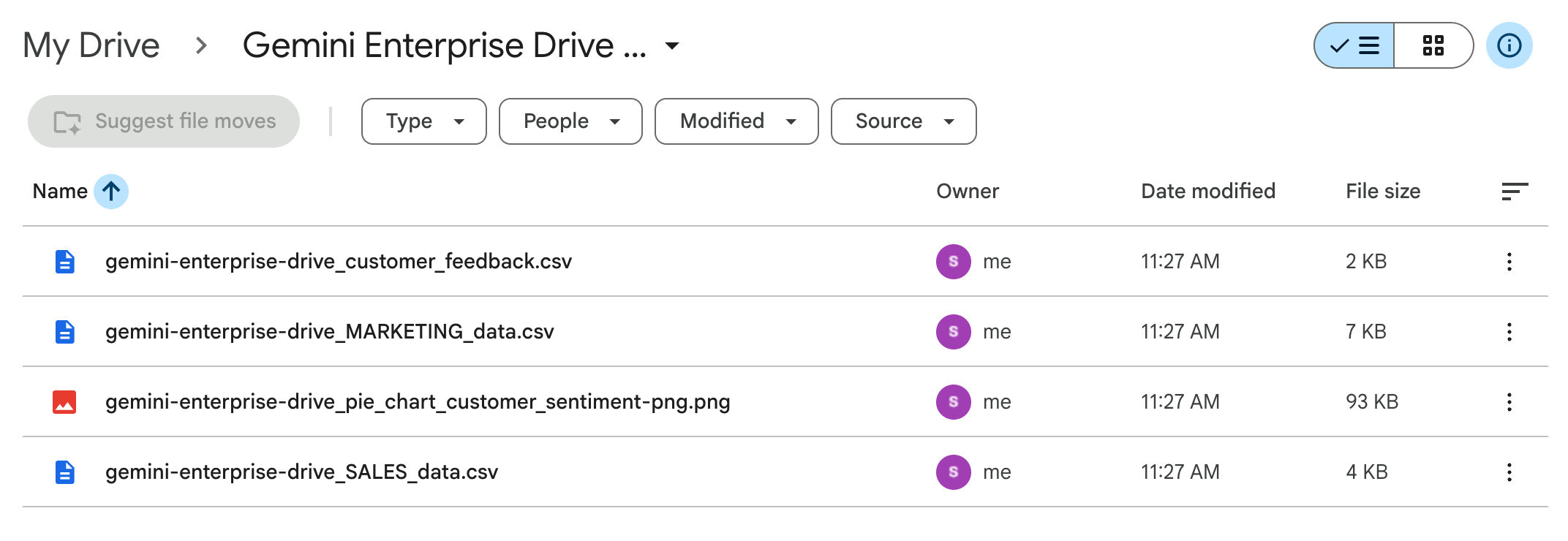
Upload the .csv files and the .png file you just downloaded from the gemini-enterprise-drive/ Cloud Storage folder into this newly created Gemini Enterprise Drive Assets Google Drive folder. Your folder should resemble the following (containing the four files):
Download text files for Gemini Notebook
-
Return to your Cloud Storage browser tab, and navigate into the notebooklm-drive/ folder.
-
Download all the plain text (.txt) files listed below from this folder to your local system. These files are specifically prepared for use with Gemini Notebook, and you use them in a later task.
MARKETING_data.txtSALES_data.txtcustomer_feedback.txt
Important Note on Downloading .txt Files: When you click on a .txt file link in the Cloud Storage browser UI, your browser might open and display the content as a plain text page instead of directly downloading the file.
If this happens:
- To save the file, use your browser's "Save Page As..." option, typically by pressing CTRL+S (on Windows/Linux) or CMD+S (on Mac).
- Ensure you save the file with its original name and the
.txt extension (e.g., SALES_data.txt).
Add an event to Google Calendar
-
In the same Incognito window, open another new tab and navigate to Google Calendar. Accept or dismiss any pop-up messages.
-
Confirm that you are logged in with your student account by checking the profile icon in the upper-right corner.
-
In Google Calendar, click Create > Event.
-
In the event creation window that appears:
- For Title, type Cymbal Foods - Marketing Strategy Meeting.
- Set a start time that is at least one hour from the current time.
- (Optional) Add any other relevant details if you wish.
-
Click Save.
Click Check my progress to verify the objective.
Add content to Google Drive and Google Calendar.
Task 2. Create the Gemini Enterprise application
In this section, you perform the initial one-time configuration for Gemini Enterprise within your enterprise environment by creating the application and setting up Google Identity as the identity provider.
Administrator vs. End User Setup: In a typical organization, setting up the application, configuring OAuth credentials, and connecting enterprise data stores are one-time administrative tasks performed by IT administrators. In this lab, you act as the administrator to build the environment before exploring the application as an end user.
Configure Gemini Enterprise
-
In the Google Cloud console, search for Gemini Enterprise in the top search bar, and then select Gemini Enterprise.
-
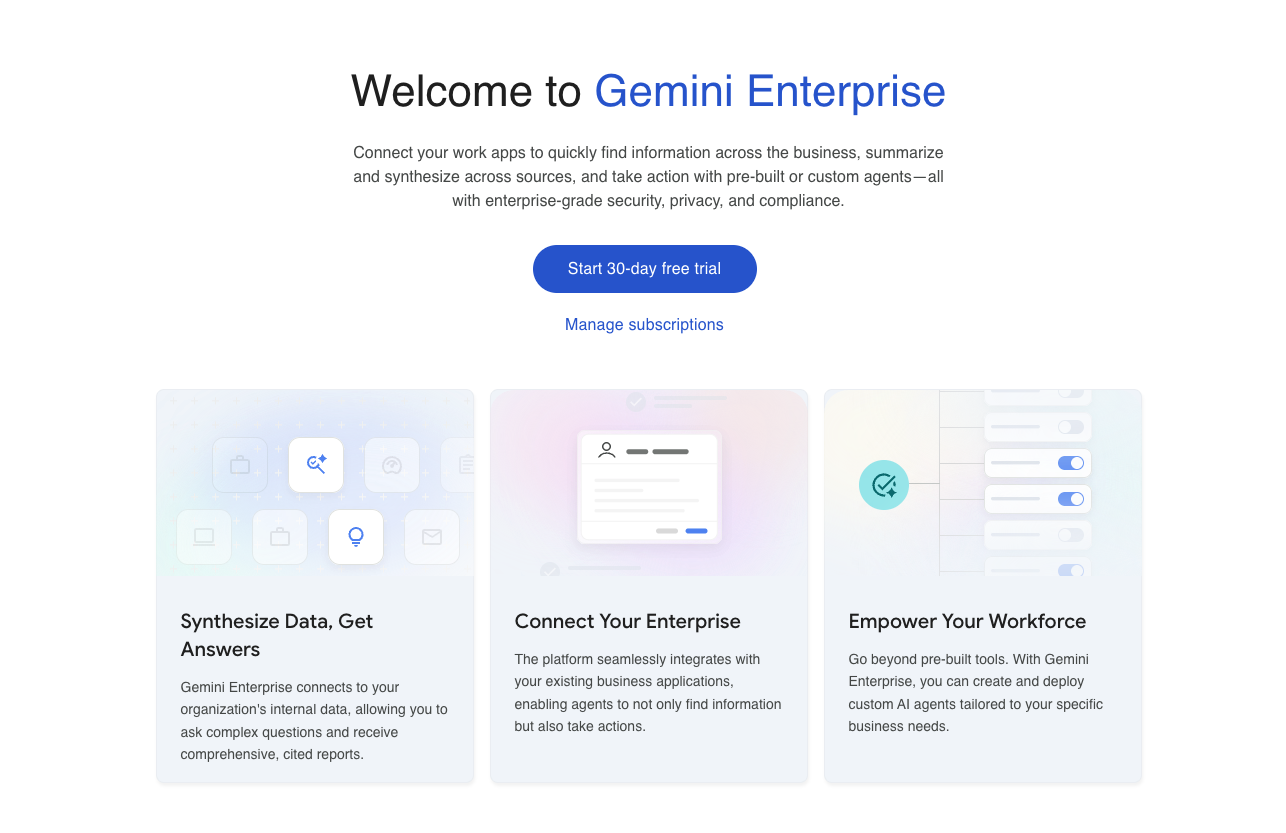
On the Gemini Enterprise card, click Start 30 Day Free Trial.
-
When prompted to enable the Gemini Code Assist API, click Continue and Activate the API.
-
Once you are redirected to the Create page, for App name, type Cymbal Foods - Gemini Enterprise.
-
For Location, select global.
-
Click Create.
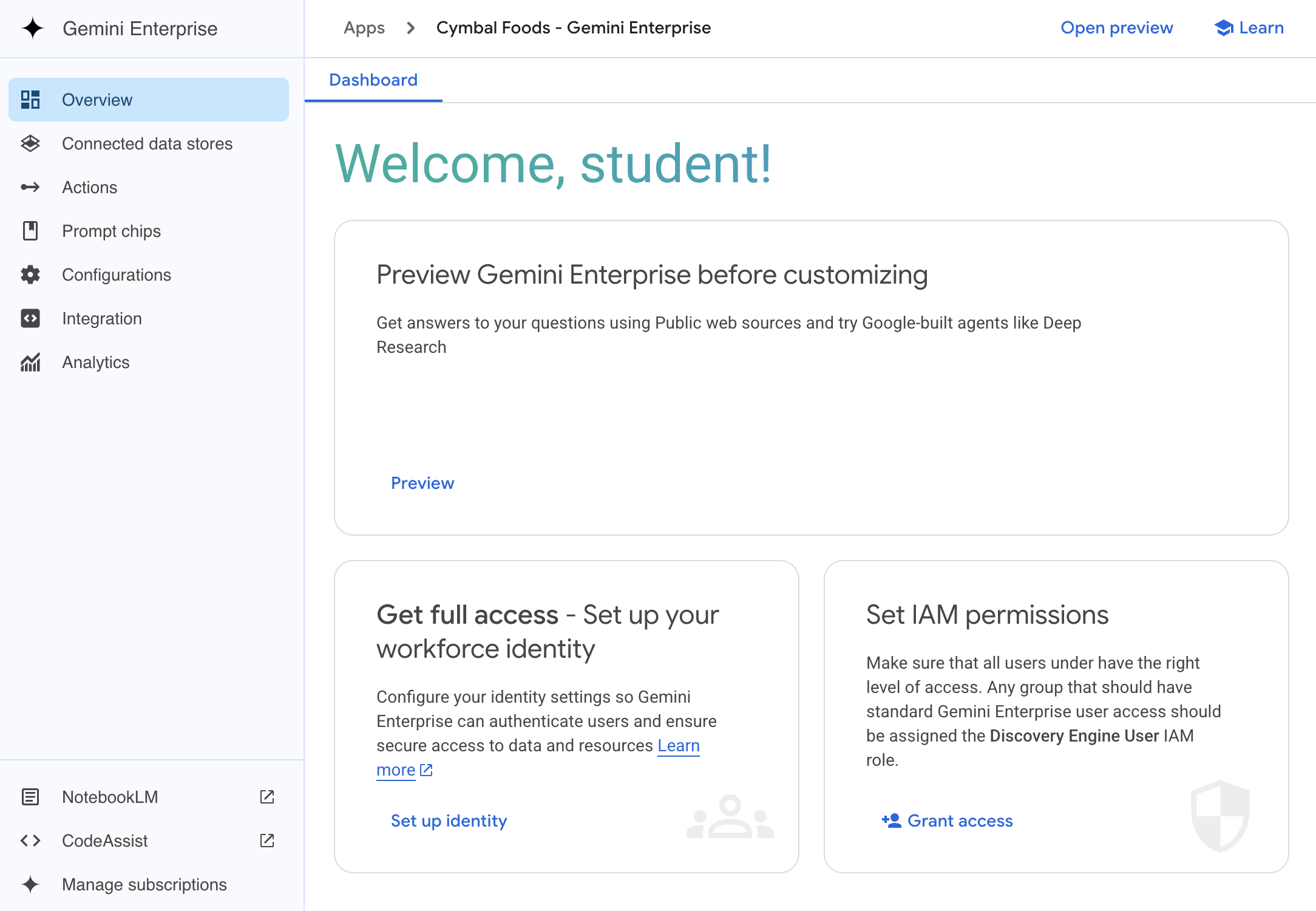
Your Gemini Enterprise app has been created. It should resemble the following:
-
Click Set up identity.
-
Select Use Google Identity, and then click Confirm Workforce Identity.
-
In the left navigation menu, select Configurations.
-
Click the Feature Management tab.
-
Click the toggle next to Enable chat agents to turn it on.
-
Click the toggle next to Enable workflow agents to turn it on.
-
Click the toggle next to Enable canvas to turn it on.
-
Click Save.
Brand your application (Optional)
-
Click the Search UI tab.
-
Under Appearance and branding options, for Logo image, paste the following URL:
https://storage.googleapis.com/spls/gemini-enterprise/cymbal-foods-logo.png
- Click Save and publish.
Click Check my progress to verify the objective.
Configure Gemini Enterprise.
Task 3. Connect to your data stores
In this section, you define the information sources for your Gemini Enterprise application by creating data stores. To securely authorize connections to external user data like Google Drive and Google Calendar, you first configure an OAuth consent screen and client. You then create connections for Google Drive, Cloud Storage, and Google Calendar.
Set up an OAuth consent screen and create a client
-
In the Google Cloud console, search for Google Auth Platform in the top search bar, and then select Google Auth Platform.
-
Click Get Started.
-
For App Name, type Cymbal Foods Gemini Enterprise.
-
For User support email, select your student account.
-
Click Next.
-
For Audience, select Internal.
-
Click Next.
-
For Contact Information, type .
-
Click Next.
-
Select the checkbox to agree to the terms.
-
Click Continue.
-
Click Create.
-
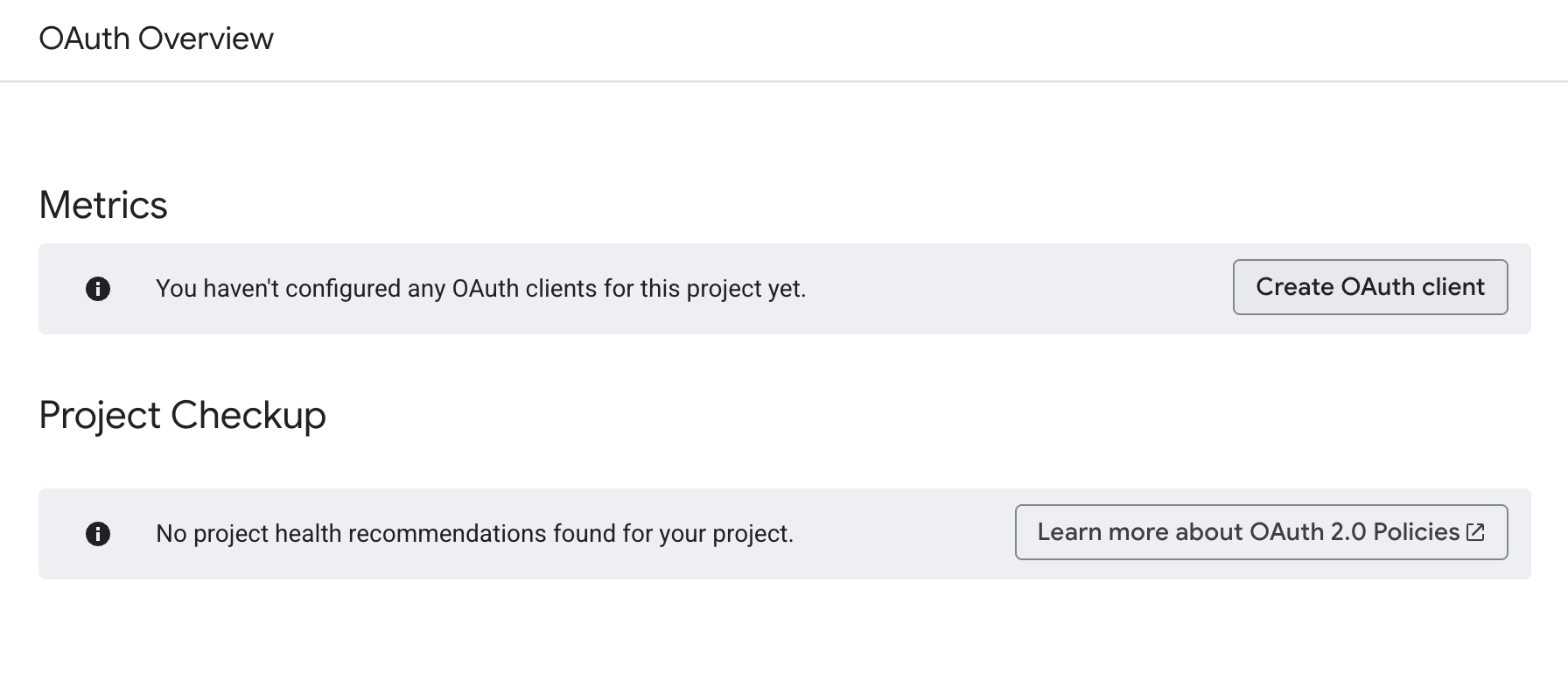
Click Create OAuth Client.
-
For Application type, select Web application.
-
For Name, type Gemini Enterprise Client.
-
Under Authorized redirect URIs, click Add URI.
-
For URI 1, type https://vertexaisearch.cloud.google.com/oauth-redirect.
-
Click Create, and then click OK.
-
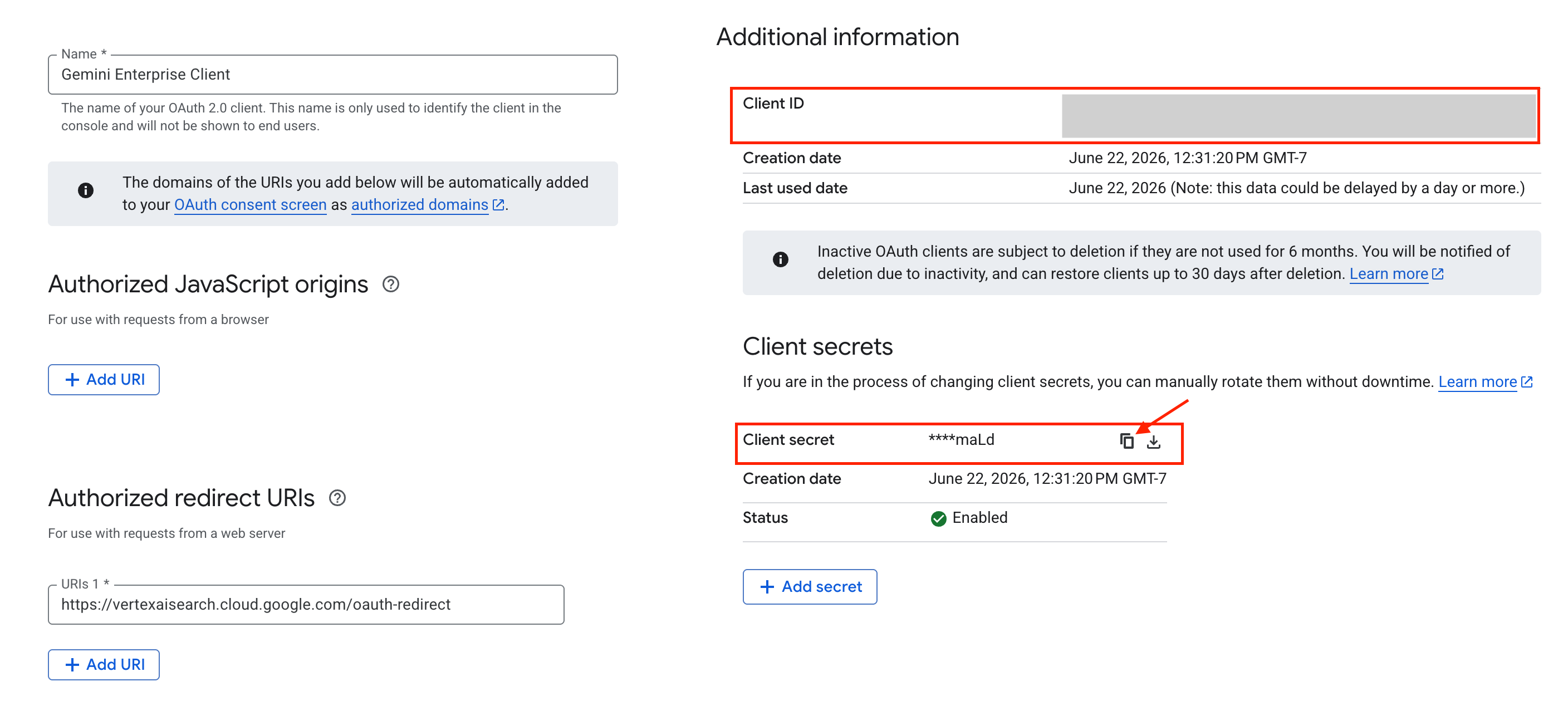
In the OAuth clients list, click Gemini Enterprise Client. You are redirected to the OAuth Client page.
-
Under Additional information, copy the Client ID value to a text document on your local computer.
-
Under Client secrets, click the copy icon next to Client secret to copy the secret to your text document.
Note: Keep your text document open, as you paste these values in the next task to connect your data stores.
Create a Google Drive data store
-
From the Gemini Enterprise Applications menu, select Cymbal Foods - Gemini Enterprise, and then select Connected data stores from the left navigation pane.
-
Click New Data Store.
-
On the Google Drive card, click Add data source.
-
For Client ID, paste your saved OAuth Client ID.
-
For Client Secret, paste your saved OAuth Client Secret.
-
Click Verify Auth.
-
In the Google sign-in pop-up window, select your student account.
-
Click Allow.
-
Click Continue.
-
Leave the Data section unchanged.
-
Click Continue.
-
On the Action tab, select Skip.
Note: While Gemini Enterprise makes it easier to find information across your data sources, it does not grant additional access. You will still only have access to the documents that have been shared with you via existing Drive permissions, and others will only have access to your documents that you have shared with them.
-
Click Continue.
-
For Region, select global.
-
For Data connector name, type Google Drive.
-
Leave the remaining settings as their defaults.
-
Click Create.
Create a Google Calendar data store
- Follow the procedure in the previous task to create a data store for Google Calendar. For Client ID and Client Secret, paste the credentials you saved earlier. On the Action tab, select Skip, and for Data connector name, type Google Calendar.
Create a Cloud Storage data store
-
From the Gemini Enterprise Applications menu, select Cymbal Foods - Gemini Enterprise, and then select Connected data stores from the left navigation pane.
-
Click New Data Store.
-
Locate the Cloud Storage card and click Add data source.
-
For Data type, select Documents from the Unstructured Data Import (Document Search & RAG) section.
-
For Synchronization frequency, select One time.
-
For Cloud Storage folder, click Browse, select the gemini-enterprise-cloud-storage folder within your bucket, and click Select.
-
Click Continue.
-
For Region, select global, and for Data connector name, type Cloud Storage.
-
If prompted for billing, leave the pricing model as default, and then click Continue.
-
Click Create.
-
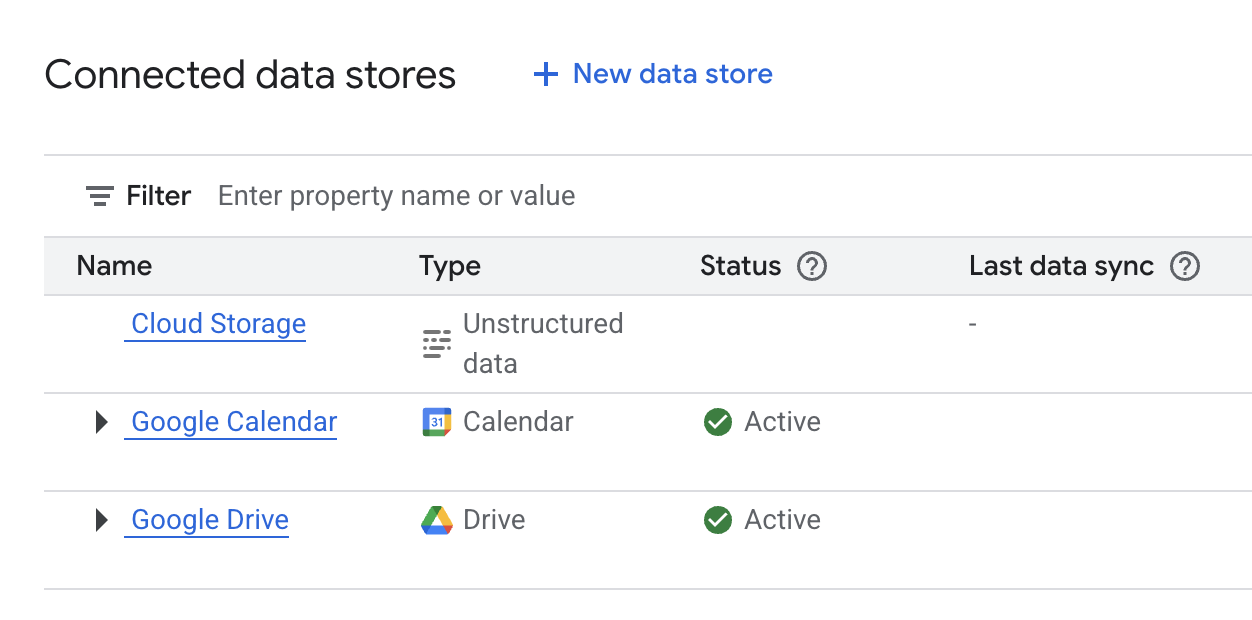
The three data stores should be listed in the Gemini Enterprise > Cymbal Foods - Gemini Enterprise > Connected data stores panel.
Click Check my progress to verify the objective.
Create Google Drive, Calendar, and Cloud Storage data stores.
Task 4. Interact with your Gemini Enterprise agents
Now that your Cymbal Foods Gemini Enterprise application is configured and connected to your data, you experience its capabilities firsthand. In this task, you interact directly with agents to search your uploaded documents, extract specific information, and summarize content. This hands-on exploration showcases how Gemini Enterprise transforms information retrieval and task management within an organization.
Note: It may take 5–10 minutes for your data stores to fully index. If you don't see the sources populated on the Gemini Enterprise application, please wait a few minutes and try again.
-
From the Gemini Enterprise page, click the Overview tab.
-
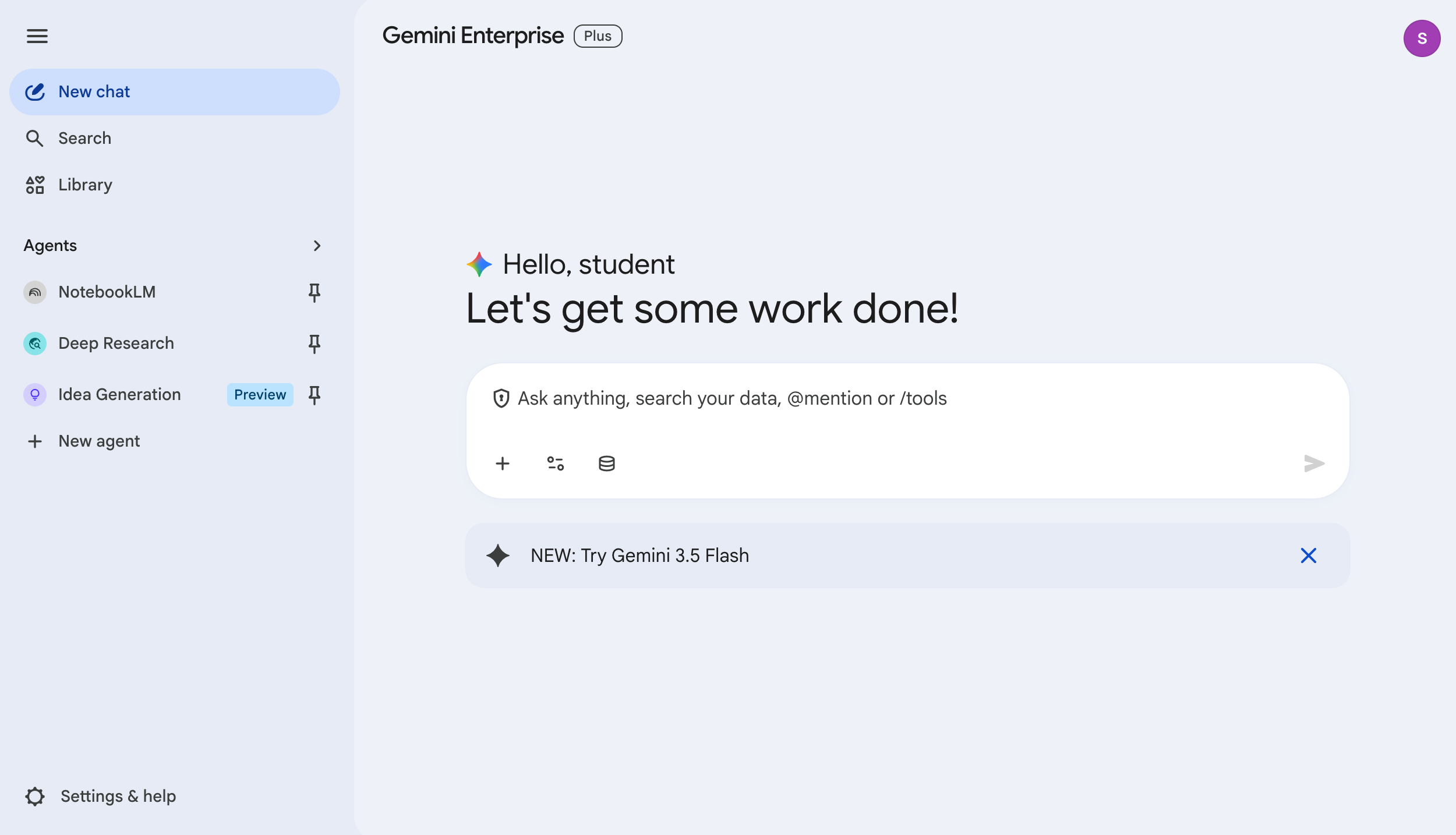
Click the URL under Your Gemini Enterprise webapp is ready to open the application. Note that this will look different depending on the data stores used. Your home page should resemble the following:
-
This home page is designed to give users easy access to the content and events they will find most useful. You will see a few sections:
-
Agents: Use Google-provided agents or create your own to help with tasks like research, iterating on ideas, or workflow automation.
-
Gemini Notebook: An AI-powered research and writing assistant that works best with the sources you upload.
-
Deep Research: An agentic feature in Gemini that can automatically browse up to hundreds of websites on your behalf, think through its findings, and create insightful multi-page reports in minutes.
Note: If your data stores are still indexing, the files may require a little time to become accessible.
-
In the chat box, click Connectors (the database icon) to view your available data sources.
-
Next to Drive, click Authorize.
-
Next to Calendar, click Authorize.
-
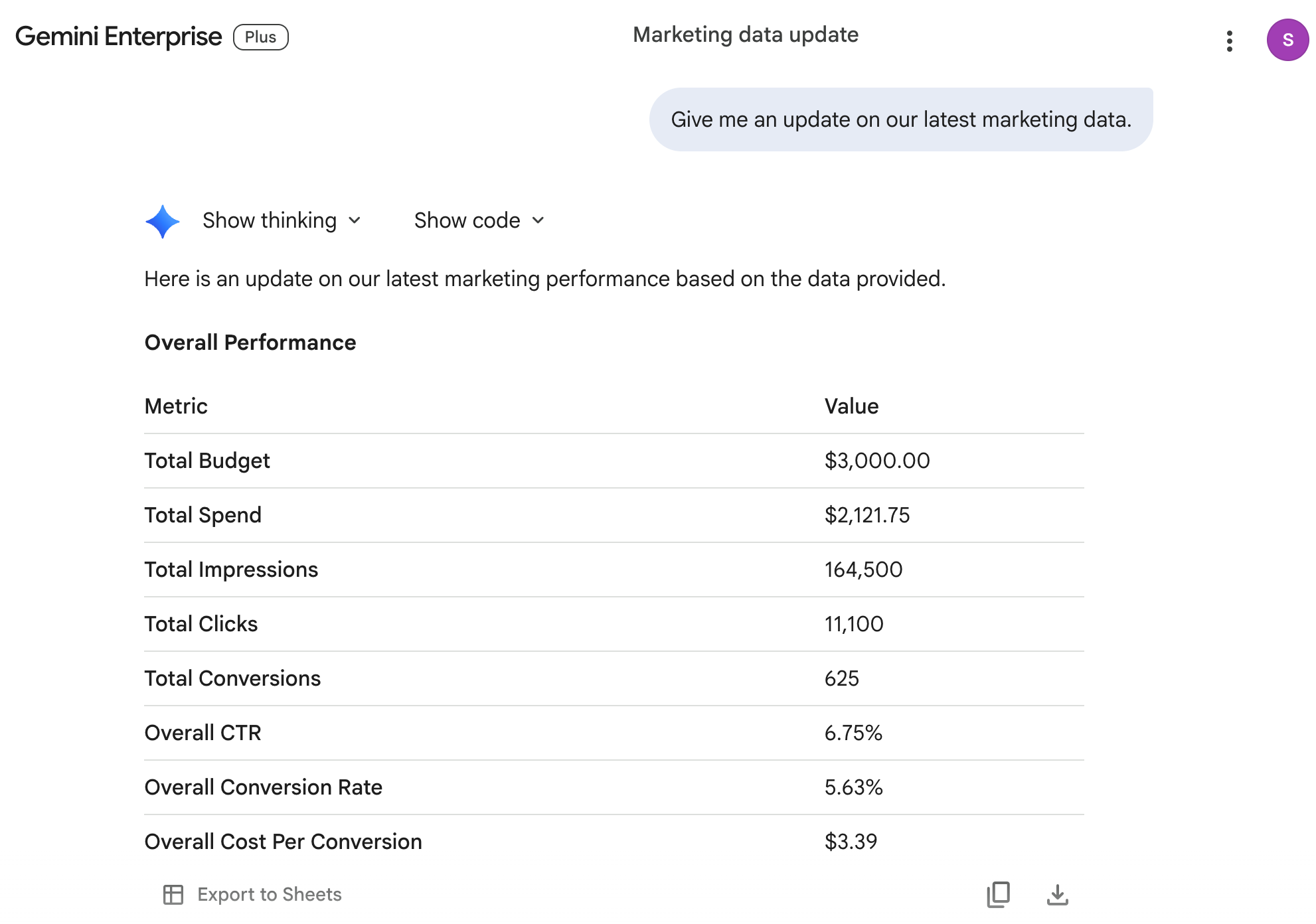
In the chat box, enter the following prompt:
Give me an update on our latest marketing data.
Your answer should resemble the following:
Note: If no response is received, please refresh and submit the query again.
- As a followup, ask:
What products were in the March newsletter?
You can use the Gemini Enterprise AI assistant to handle multimodal prompts as well.
-
In the upper-left corner, click New chat to start a new chat.
-
In the search bar, click Tools, and select Search Company data.
-
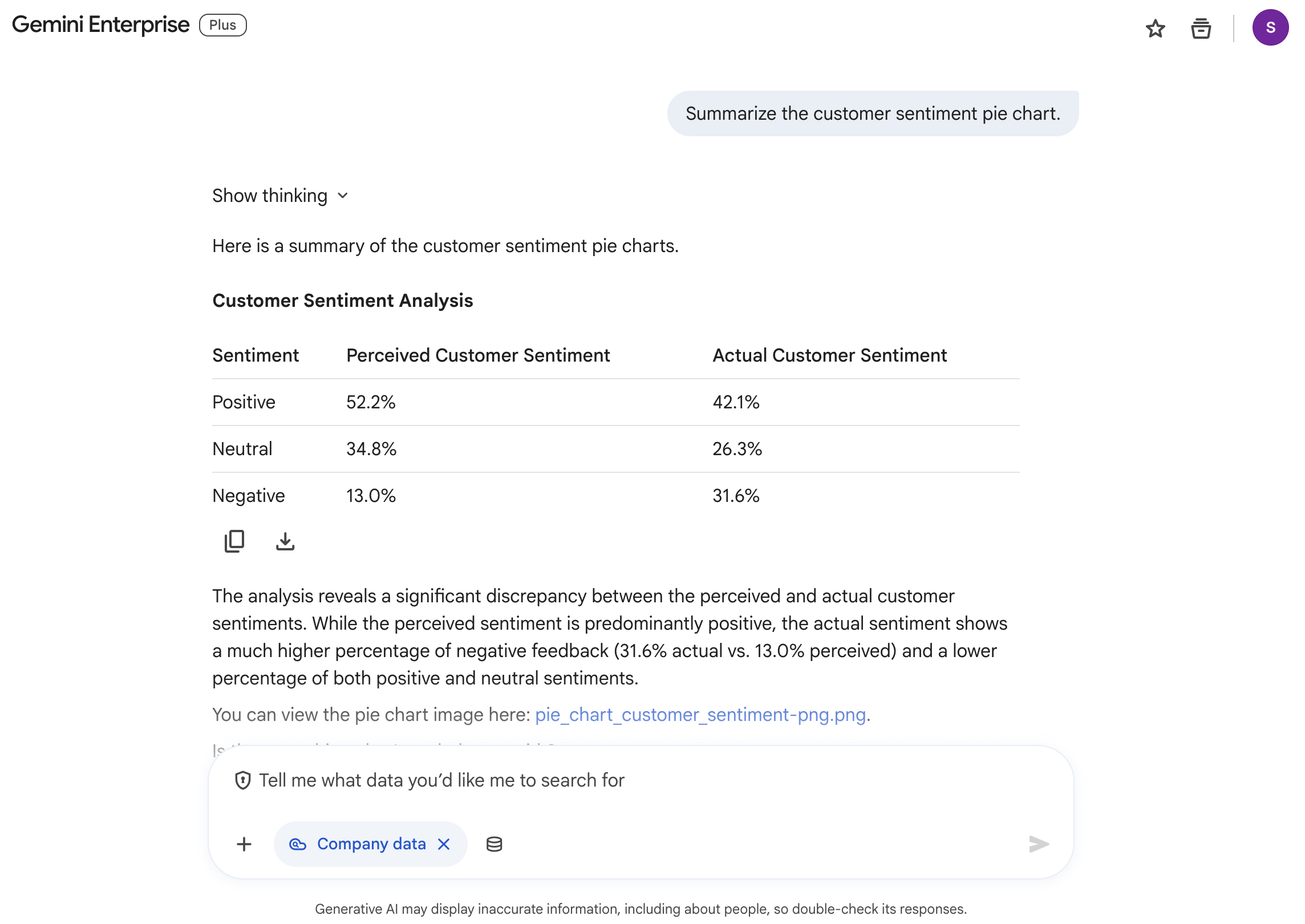
Enter the following prompt:
Summarize the customer sentiment pie chart.
The response should resemble the following:
Note: You may need to run the query again if it doesn't find the pie chart image file you uploaded.
-
In the upper-left corner, click New chat to start a new chat.
-
Enter the following prompt:
What meetings are on my agenda today? What do I need to have prepped for them?
Observe the response. Since you set up the data stores for your Google Calendar, it knows what events you have, and can assist you in curating the information you need for them!
Build a custom agent with Agent Designer
In this section, you use the visual Agent Designer to create a custom agent tailored to your enterprise sales data.
-
Click the Google Gemini Enterprise (or Cymbal Foods) logo to return to the homepage.
-
In the left navigation menu, click + New Agent.
-
In the Agent Designer chat panel on the left, enter the following prompt:
Create a Sales Assistant agent that analyzes quarterly transaction data and customer feedback.
- Press ENTER to submit the request and populate the flow structure on the canvas.
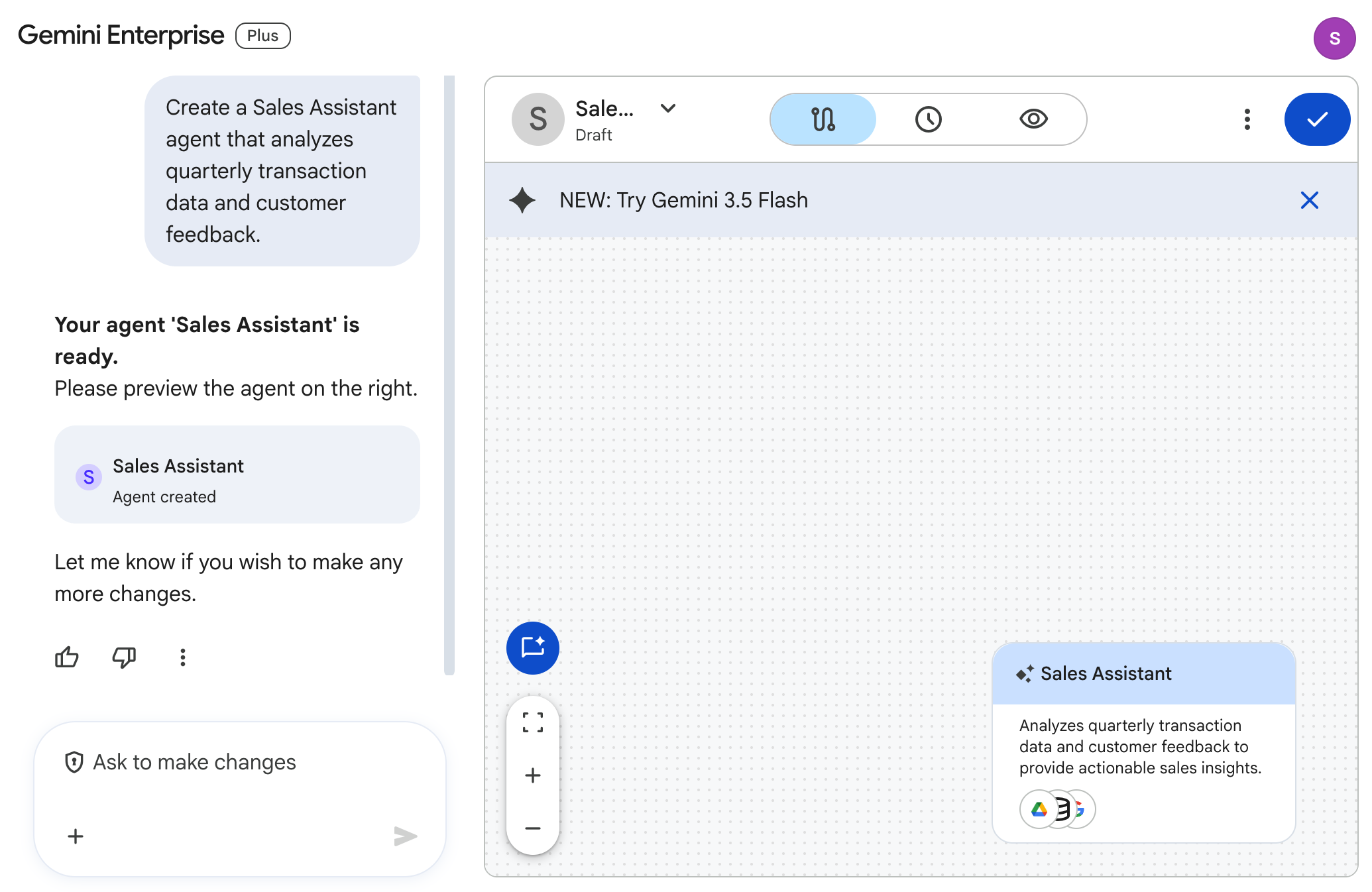
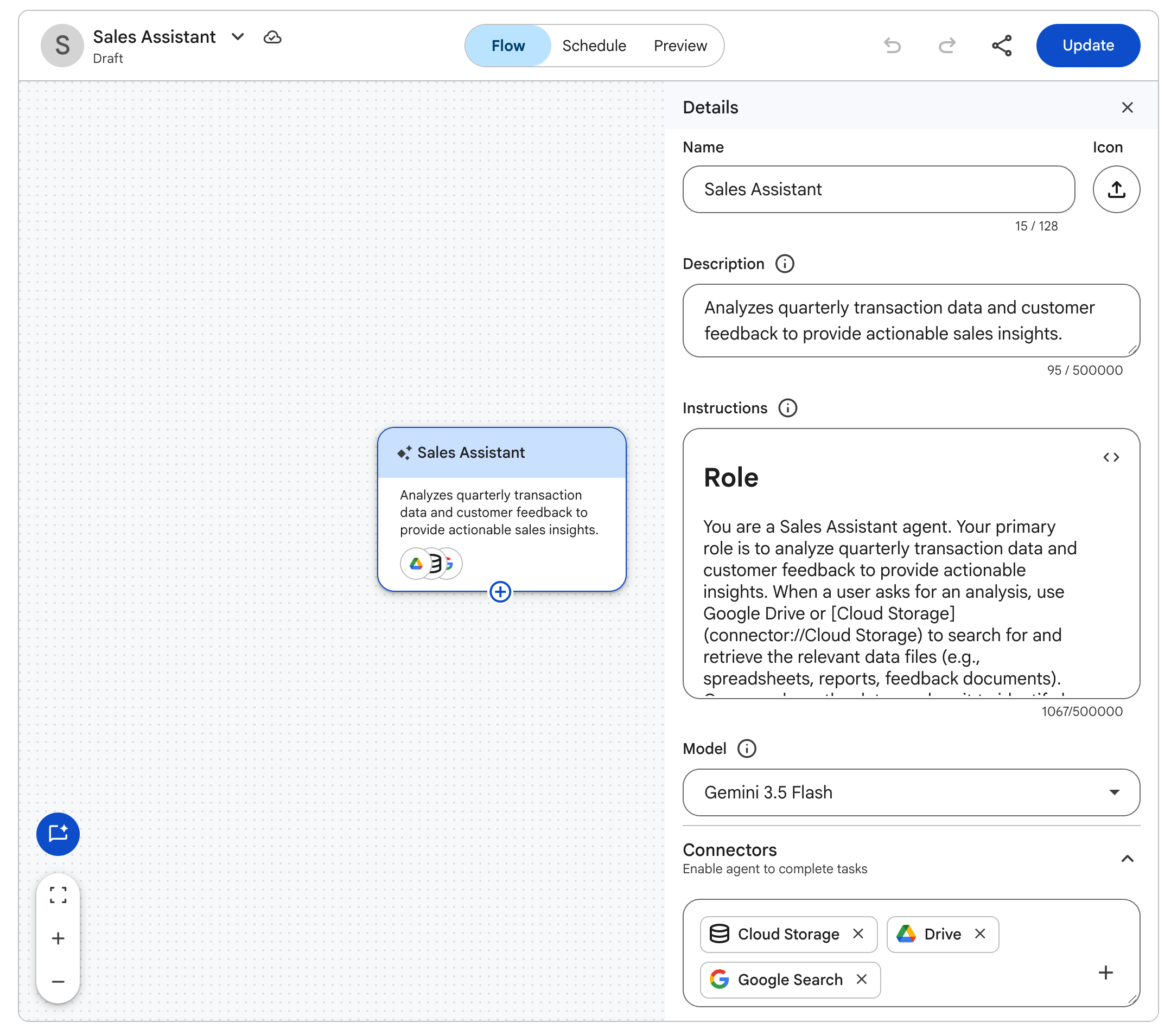
- On the Flow canvas, click the Sales Assistant node to open the details pane.
-
In the Details pane under Connectors, verify that Cloud Storage, Drive, and Google Search are enabled.
-
At the top of the canvas, click Preview to test your agent.
-
In the preview chat bar, enter the following prompt:
Summarize the key takeaways from our Q1 2026 sales records.
-
Inspect the generated analysis.
-
At the top right of the canvas, click Create to publish your custom agent to your workspace.
-
Click the Google Gemini Enterprise (or Cymbal Foods) logo to return to the homepage.
-
In the left navigation menu, click Agents.
-
Verify that your published Sales Assistant agent is listed under Your agents.
Click Check my progress to verify the objective.
Interact with your Gemini Enterprise agents.
Task 5. Use the Deep Research agent
In this section, you use the Deep Research agent to unlock deep insights with AI-driven research, reports, and audio summaries.
-
Click the Google Gemini Enterprise (or Cymbal Foods) logo to return to the homepage.
-
In the left navigation menu, select Deep Research.
-
Enter the following prompt:
Research the latest marketing tips and tricks that food companies are using, and generate a list of actionable steps our company can take to improve our current marketing strategy.
The agent will come up with a research plan for you.
- Scroll down, and click Start Research to begin the task.
Note: Since Cymbal Foods is a fictitious company, the internal data of the current marketing strategy is illustrative. The goal of this task is to demonstrate the capabilities of the Deep Research agent.
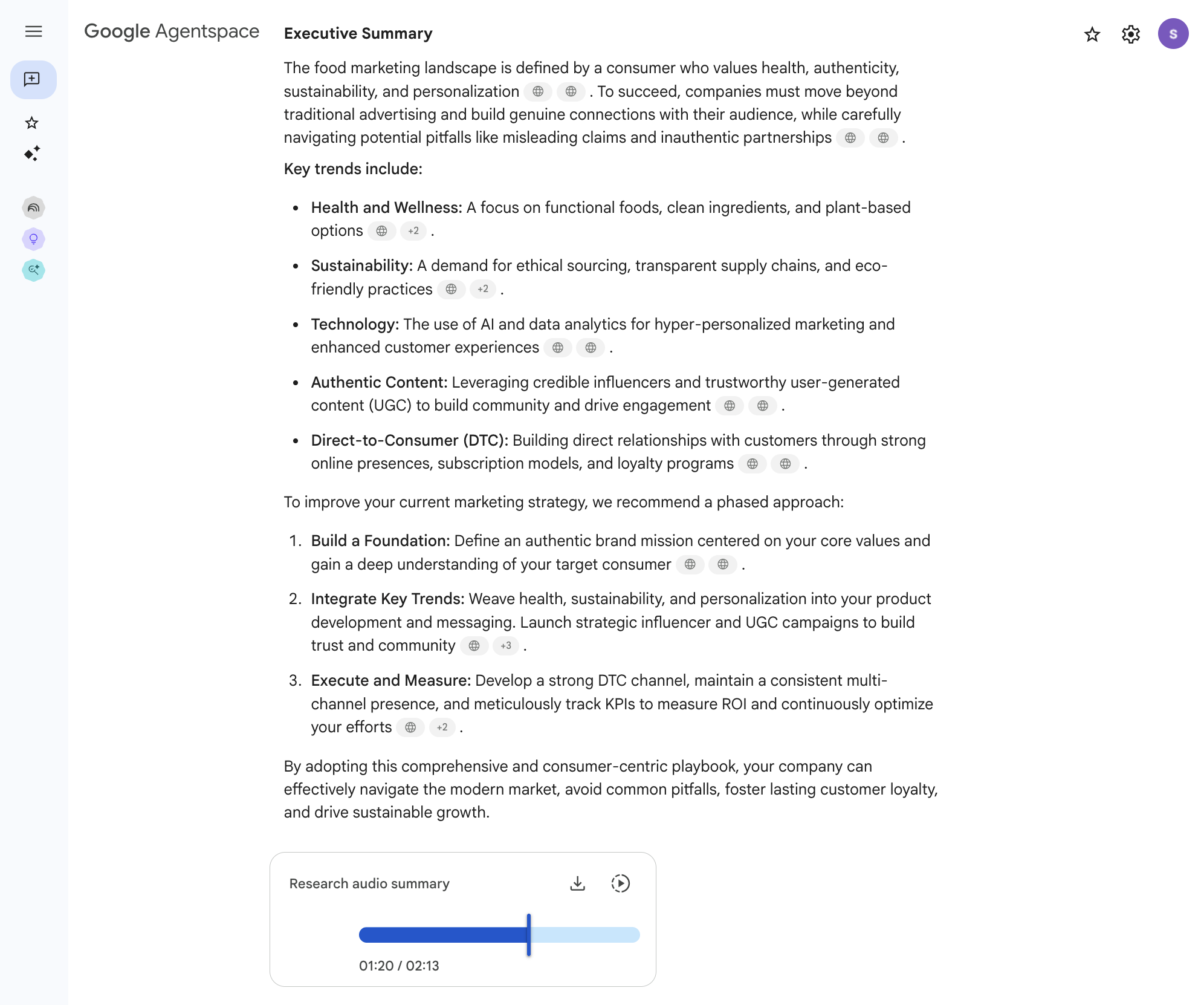
This will take a few minutes to complete. You can choose to wait or continue on with the tasks in the lab, and come back to it later to check on the status of the generated report. After 5–10 minutes, your research report will be completed, and you will see the following summary and audio overview!
Task 6. Analyze enterprise documents with Gemini Notebook
In the previous tasks, you explored Gemini Enterprise as a comprehensive platform for accessing enterprise information and using specialized AI agents. Now, you delve into Gemini Notebook, a tool designed for focused research, deep analysis, and sense-making with specific collections of documents. Gemini Notebook acts as your personal research assistant, allowing you to upload your chosen sources and then ask detailed questions, generate summaries, and synthesize information, with all AI responses grounded directly in the materials you provide.
For Cymbal Foods, an employee might use Gemini Notebook to conduct an in-depth review of specific sales reports alongside customer feedback trends before drafting a new product proposal or marketing strategy. In this task, you create a new notebook, add text versions of your Cymbal Foods data files as sources, and interact with Gemini Notebook to gain insights from this curated collection.
Create a Cymbal Foods analysis notebook
-
On the homepage of your Cymbal Foods Gemini Enterprise app, in the left navigation pane, click Gemini Notebook.
-
On the Gemini Notebook home page, click Create New Notebook to start your focused analysis project.
-
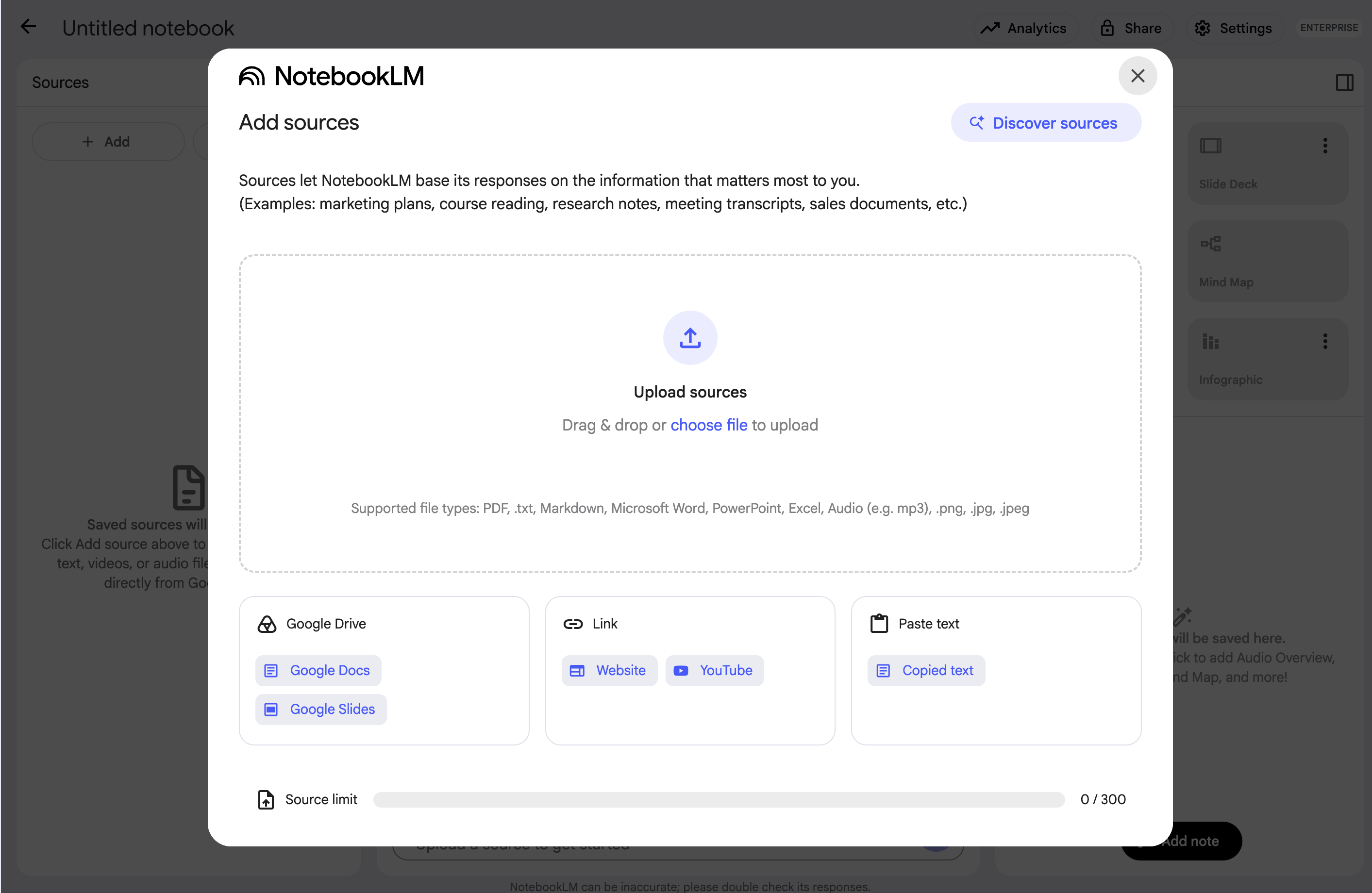
The Add sources dialog appears, allowing you to select the documents Gemini Notebook uses for its analysis. It resembles the image below:
-
In the Add sources dialog, click Choose file.
-
Select the following .txt files (downloaded in Task 1):
SALES_data.txtcustomer_feedback.txtMARKETING_data.txt
-
Click Open to add these files as sources to your notebook.
-
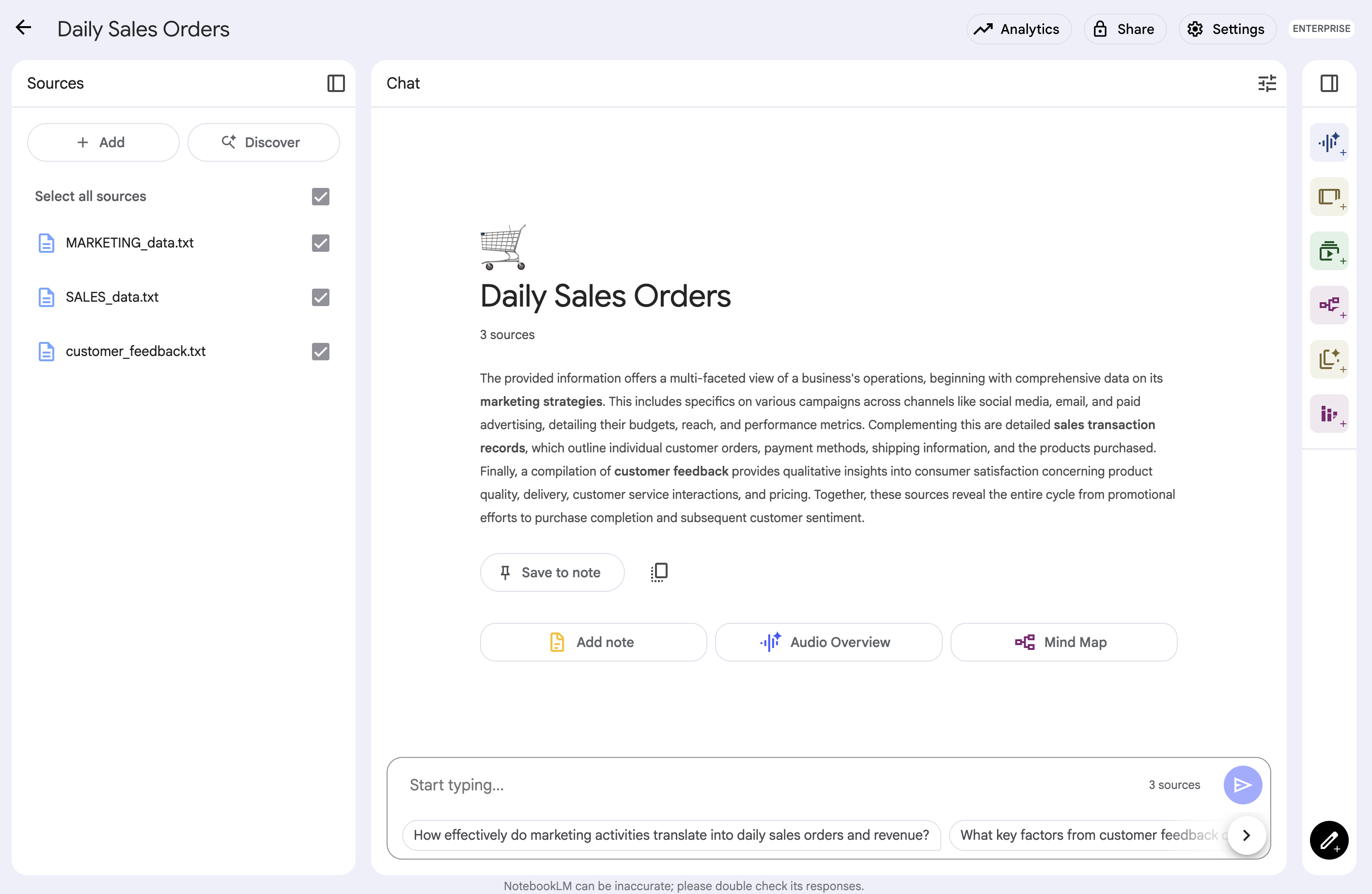
Wait for Gemini Notebook to process your selected sources, which then appear listed within your notebook.
Your Gemini Notebook interface resembles the following:
Query uploaded sources in Gemini Notebook
With your Cymbal Foods data loaded into the notebook, you can now ask targeted questions and explore the content.
-
Observe the Gemini Notebook interface, which displays your added sources, a central chat section, and a Studio section for your notes and the Audio Overview.
-
In the chat input bar, type your questions. Gemini Notebook generates answers based only on the content of the documents you upload into this specific notebook. Try the following prompts:
-
Query 1:
What audience did the Spring Cookie Promotion target?
-
Query 2:
Summarize the key themes from the customer_feedback.txt regarding products that had sales figures reported in Q1 2026 in the SALES_data.txt.
-
Query 3:
Are there any marketing campaigns in MARKETING_data.txt that correspond to products with significant customer feedback or notable sales trends from the other documents?
-
Query 4 (General inquiry about a single document):
What are the top 3 most frequently mentioned positive aspects in the customer_feedback.txt?
Notice how Gemini Notebook formulates its answers, drawing information directly from your uploaded text files. Many grounded AI tools, including Gemini Notebook, provide citations or highlight the source text used to generate an answer. These citations help you verify the information and refer back to the original context in your documents. Gemini Notebook is designed for iterative exploration, allowing you to ask follow-up questions to dive deeper into specific points.
It is different from the broader Gemini Enterprise search (which queries across all connected data) or the specialized Data Analyst Agent (which operates based on its specific programmed instructions). Gemini Notebook offers a flexible environment for any collection of sources you want to study closely.
A key feature of Gemini Notebook is often the ability to save AI responses, key passages from sources, or your own thoughts as "notes" within the notebook. This helps you build a structured understanding and gather material for reports or further work.
Beyond textual summaries and Q&A, Gemini Notebook offers innovative ways to synthesize information from your sources through Studio features like Audio Overview, Infographic, and Slide Deck. This allows you to generate spoken summaries, visual data sheets, and presentation decks derived from the documents you added to your notebook.
- In the Studio section, click Audio Overview, Infographic, and Slide Deck.
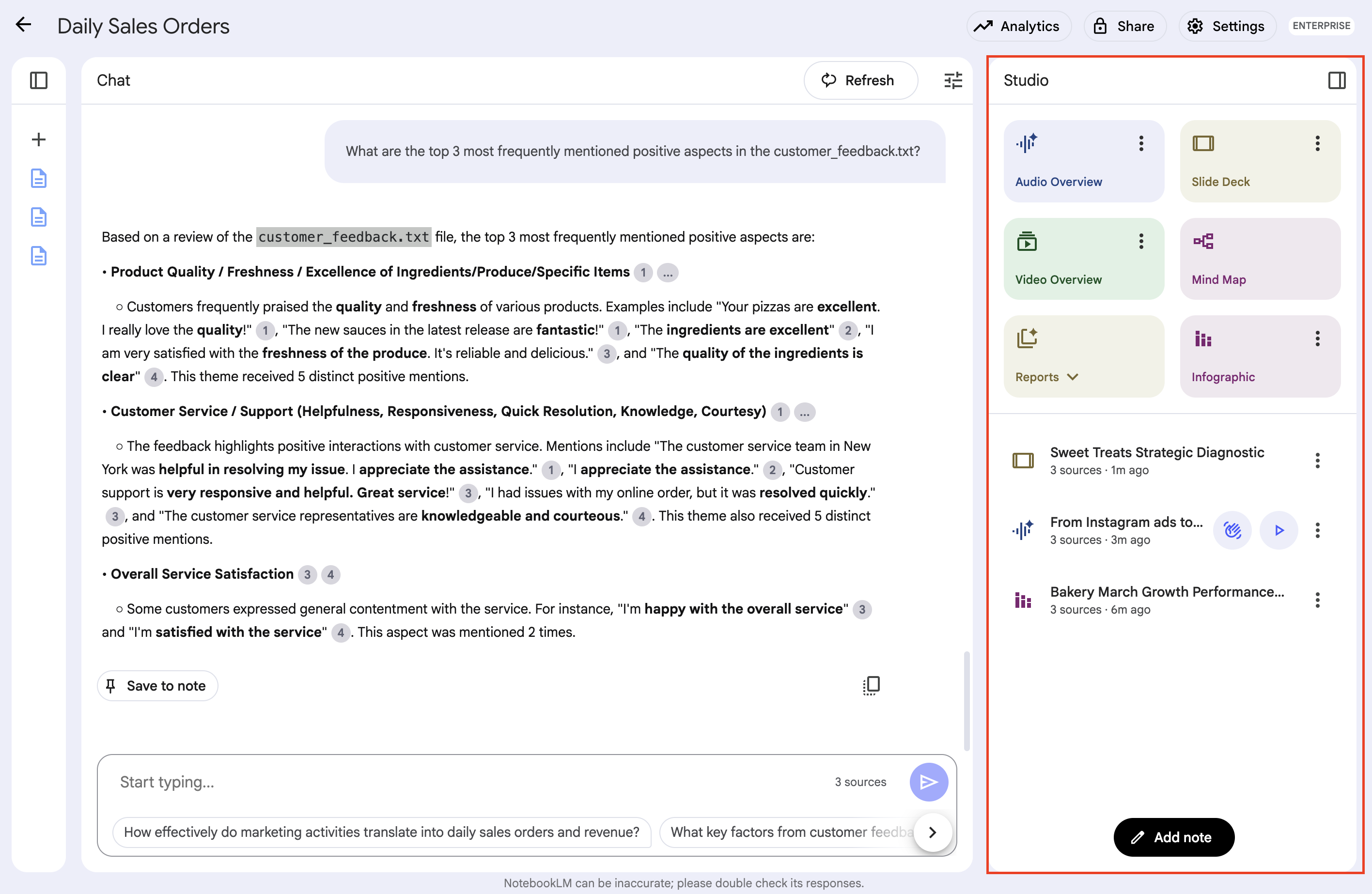
Note: These studio artifacts generate in the background and may require a few minutes to complete.
- Listen to the generated Audio Overview and inspect the visual Infographic and Slide Deck. Consider how accurately these multimodal synthesis tools capture the main themes from your uploaded Cymbal Foods documents.
Click Check my progress to verify the objective.
Focused analysis with Gemini Notebook.
Continue exploration (Optional)
You've now covered the core exercises for Gemini Notebook and Gemini Enterprise in this lab! If you have remaining time, this is an excellent opportunity to delve deeper and experiment further with both tools:
In Gemini Notebook:
-
Experiment with different questions: Go beyond the example queries. Try asking for comparisons, potential implications (based only on the text), or asking Gemini Notebook to explain a concept using examples from your documents.
-
Explore note-taking: Investigate the "Notes" feature more thoroughly. Try saving key AI responses, extracting important quotes from your sources into notes, and writing your own annotations to build a more structured understanding.
-
Test other features: Look for other available features in the Gemini Notebook interface, such as suggested questions or different views, and see how they can aid your analysis.
In your Gemini Enterprise app:
-
General AI assistant: Return to the main search/chat interface of your deployed Cymbal Foods - Gemini Enterprise app. Try different or more complex queries. For example, ask it to compare information that might come from different connected data stores (e.g., "Are there any marketing campaigns for products that have recent customer feedback entries in Drive, and do any of these align with upcoming calendar events?").
-
Test interactive canvas: Prompt the assistant to draft a marketing proposal or strategy document, and then use the side-by-side Canvas editor to refine, edit, and format the generated content.
-
Experiment with Agent Designer: Revisit the visual Agent Designer (
+ New Agent) to build additional custom agents. Try adjusting system instructions, attaching specific data connectors, or prompting the copilot to build multi-step workflow logic.
-
Share sessions and agents: Explore enterprise collaboration capabilities by inspecting the share menu on your active chat conversations or custom-built agents to see how teams distribute AI workflows.
-
Analyze Deep Research findings: Return to the Deep Research agent to examine the detailed report and its actionable insights.
-
Explore pre-built agents: In the Agents section of your Gemini Enterprise app's homepage, see if any Google-provided example agents are listed and try interacting with them to understand their capabilities.
This self-directed exploration is a great way to solidify what you've learned and discover even more potential uses for these powerful AI tools in managing and understanding enterprise information.
Congratulations!
Congratulations! You've successfully deployed and explored Google Gemini Enterprise. Throughout this lab, you've configured data stores, interacted with different agents for search and summarization, and performed focused document analysis with Gemini Notebook, even generating multimodal overviews. These hands-on skills are invaluable for leveraging Google's advanced AI to unlock enterprise knowledge and streamline decision-making.
Next steps / learn more
For more information about Gemini Enterprise, see the following pages:
Manual Last Updated August 25, 2026
Lab Last Tested August 25, 2026
Copyright 2026 Google LLC. All rights reserved. Google and the Google logo are trademarks of Google LLC. All other company and product names may be trademarks of the respective companies with which they are associated.