Build a Certification Study Guide: PMLE
Earned gen 2, 2026 EST
Deploy an Agent with Agent Development Kit (ADK)
Earned nov 14, 2025 EST
Deploy Multi-Agent Systems with Agent Development Kit (ADK) and Agent Engine
Earned nov 12, 2025 EST
Developing Applications with Cloud Run on Google Cloud: Fundamentals
Earned ott 29, 2025 EDT
Gen AI Agents: Transform Your Organization
Earned ott 23, 2025 EDT
Gen AI Apps: Transform Your Work
Earned ott 21, 2025 EDT
Gen AI: Navigate the Landscape
Earned ott 20, 2025 EDT
Gen AI: Unlock Foundational Concepts
Earned ott 13, 2025 EDT
Introduction to NotebookLM
Earned ott 10, 2025 EDT
Gen AI: Beyond the Chatbot
Earned ott 9, 2025 EDT
Introduction to AI Applications
Earned ott 7, 2025 EDT
Improve Vertex AI Search and Gemini Enterprise Search Results
Earned ott 6, 2025 EDT
Vertex AI Search and Gemini Enterprise Analytics
Earned ott 3, 2025 EDT
Vertex AI Search and Gemini Enterprise UI Configurations
Earned ott 3, 2025 EDT
Analyze patterns in conversational data with Customer Experience Insights
Earned ago 25, 2025 EDT
Extend virtual agents with webhooks, tools, and Messenger integration
Earned ago 22, 2025 EDT
Extend CX Agents with Vertex AI Search data stores
Earned ago 21, 2025 EDT
Configure AI Applications to optimize search results
Earned ago 8, 2025 EDT
Extend Gemini with controlled generation and Tool use
Earned ago 6, 2025 EDT
Create media search and media recommendations applications with AI Applications
Earned ago 4, 2025 EDT
Extend Gemini Enterprise Assistant Capabilities
Earned ago 2, 2025 EDT
Create Data Stores for Gen AI Applications
Earned lug 29, 2025 EDT
Create and maintain Vertex AI Search data stores
Earned lug 29, 2025 EDT
Build search and recommendations applications with AI Applications
Earned lug 28, 2025 EDT
Custom Search with Embeddings in Vertex AI
Earned lug 16, 2025 EDT
Scaling with Google Cloud Operations
Earned giu 19, 2025 EDT
Trust and Security with Google Cloud
Earned giu 19, 2025 EDT
Modernize Infrastructure and Applications with Google Cloud
Earned giu 18, 2025 EDT
Innovating with Google Cloud Artificial Intelligence
Earned giu 18, 2025 EDT
Exploring Data Transformation with Google Cloud
Earned giu 16, 2025 EDT
Digital Transformation with Google Cloud
Earned giu 16, 2025 EDT
Machine Learning Operations (MLOps) with Vertex AI: Model Evaluation
Earned giu 10, 2025 EDT
Prompt Design in Vertex AI
Earned mag 19, 2025 EDT
Recommendations with AI Applications
Earned mag 16, 2025 EDT
Working with Notebooks in Vertex AI
Earned mag 14, 2025 EDT
Build a Data Warehouse with BigQuery
Earned mag 23, 2024 EDT
Serverless Data Processing with Dataflow: Foundations
Earned mag 13, 2024 EDT
Transformer Models and BERT Model - Italiano
Earned mag 8, 2024 EDT
Attention Mechanism - Italiano
Earned mag 7, 2024 EDT
Encoder-Decoder Architecture - Italiano
Earned mag 7, 2024 EDT
Introduction to Image Generation - Italiano
Earned mag 7, 2024 EDT
Introduction to Responsible AI - Italiano
Earned mag 7, 2024 EDT
Introduction to Large Language Models - Italiano
Earned mag 6, 2024 EDT
Introduction to Generative AI - Italiano
Earned mag 6, 2024 EDT
Smart Analytics, Machine Learning, and AI on Google Cloud - Italiano
Earned mag 4, 2024 EDT
Building Resilient Streaming Systems on Google Cloud Platform
Earned mag 1, 2024 EDT
Creazione di pipeline di dati in batch su Google Cloud
Earned apr 27, 2024 EDT
Modernizzazione di data lake e data warehouse con Google Cloud
Earned apr 15, 2024 EDT
Preparing for your Professional Data Engineer Journey
Earned mar 5, 2024 EST
DEPRECATED Build and Deploy Machine Learning Solutions on Vertex AI
Earned ott 22, 2023 EDT
Introduzione all'AI e al machine learning su Google Cloud
Earned ott 2, 2023 EDT
Machine Learning Operations (MLOps): Getting Started
Earned set 18, 2023 EDT
Production Machine Learning Systems
Earned set 10, 2023 EDT
Recommendation Systems on Google Cloud
Earned set 10, 2023 EDT
Natural Language Processing on Google Cloud
Earned set 6, 2023 EDT
Computer Vision Fundamentals with Google Cloud
Earned set 1, 2023 EDT
Machine learning in azienda
Earned ago 8, 2023 EDT
Feature engineering
Earned lug 29, 2023 EDT
Crea, addestra ed esegui il deployment di modelli ML tramite Keras su Google Cloud
Earned lug 16, 2023 EDT
Launching into Machine Learning - Italiano
Earned lug 4, 2023 EDT
Google Cloud Big Data and Machine Learning Fundamentals - Italiano
Earned giu 4, 2023 EDT
Configura un ambiente di sviluppo di app su Google Cloud
Earned mag 5, 2023 EDT
Infrastruttura Google Cloud elastica: scalabilità e automazione
Earned mag 5, 2023 EDT
Infrastruttura Google Cloud di base: fondamenti
Earned mag 4, 2023 EDT
Google Cloud Fundamentals: Core Infrastructure - Italiano
Earned mag 2, 2023 EDT
Implementazione di Cloud Load Balancing per Compute Engine
Earned apr 28, 2023 EDT
Preparing for Your Associate Cloud Engineer Journey
Earned apr 27, 2023 EDT
How Google Does Machine Learning
Earned apr 20, 2023 EDT
Learn how to use NotebookLM to create a personalized study guide for the Professional Machine Learning Engineer certification exam (PMLE). You'll review NotebookLM features, create a notebook, and use the study guide to practice for a certification exam.
Scopri di più
In this challenge lab, you will demonstrate your ability to author agents using Agent Development Kit (ADK), deploy those agents to Agent Engine, and use them from a web app. Complete the challenge lab to earn a Google Cloud skill badge.
Scopri di più
In this course, you’ll learn to use the Google Agent Development Kit to build complex, multi-agent systems. You will build agents equipped with tools, and connect them with parent-child relationships and flows to define how they interact. You’ll run your agents locally and deploy them to Vertex AI Agent Engine to run as a managed agentic flow, with infrastructure decisions and resource scaling handled by Agent Engine.
Please note these labs are based off a pre-released version of this product. There may be some lag on these labs as we provide maintenance updates.
Scopri di più
This course introduces the Cloud Run serverless platform for running applications.
In this course, you learn about the fundamentals of Cloud Run, its resource model and the container lifecycle.
You learn about service identities, how to control access to services, and how to develop and test your
application locally before deploying it to Cloud Run. The course also teaches you how to integrate
with other services on Google Cloud so you can build full-featured applications.
Scopri di più
Gen AI Agents: Transform Your Organization is the fifth and final course of the Gen AI Leader learning path. This course explores how organizations can use custom gen AI agents to help tackle specific business challenges. You gain hands-on practice building a basic gen AI agent, while exploring the components of these agents, such as models, reasoning loops, and tools.
Scopri di più
Transform Your Work With Gen AI Apps is the fourth course of the Gen AI Leader learning path. This course introduces Google’s gen AI applications, such as Google Workspace with Gemini and NotebookLM. It guides you through concepts like grounding, retrieval augmented generation, constructing effective prompts and building automated workflows.
Scopri di più
Gen AI: Navigate the Landscape s the third course of the Gen AI Leader learning path. Gen AI is changing how we work and interact with the world around us. But as a leader, how can you harness its power to drive real business outcomes? In this course, you explore the different layers of building gen AI solutions, Google Cloud’s offerings, and the factors to consider when selecting a solution.
Scopri di più
Gen AI: Unlock Foundational Concepts is the second course of the Gen AI Leader learning path. In this course, you unlock the foundational concepts of generative AI by exploring the differences between AI, ML, and gen AI, and understanding how various data types enable generative AI to address business challenges. You also gain insights into Google Cloud strategies to address the limitations of foundation models and the key challenges for responsible and secure AI development and deployment.
Scopri di più
NotebookLM is an AI-powered collaborator that helps you do your best thinking. After uploading your documents, NotebookLM becomes an instant expert in those sources so you can read, take notes, and collaborate with it to refine and organize your ideas.
NotebookLM Pro gives you everything already included with NotebookLM, as well as higher utilization limits, access to premium features, and additional sharing options and analytics.
Scopri di più
Gen AI: Beyond the Chatbot is the first course of the Gen AI Leader learning path and has no prerequisites. This course aims to move beyond the basic understanding of chatbots to explore the true potential of generative AI for your organization. You explore concepts like foundation models and prompt engineering, which are crucial for leveraging the power of gen AI. The course also guides you through important considerations you should make when developing a successful gen AI strategy for your organization.
Scopri di più
This course introduces AI Applications. You will learn about the types of apps that you can create using AI Applications, the high-level steps that its data stores automate for you, and what advanced features can be enabled for Search apps.
(Please note Gemini Enterprise was previously named Google Agentspace, there may be references to the previous product name in this course.)
Scopri di più
If you've worked with data, you know that some data is more reliable than other data.
In this course, you'll learn a variety of techniques to present the most reliable or useful results to your users. Create serving controls to boost or bury search results. Rank search results to ensure that each query is answered by the most relevant data. If needed, tune your search engine. Learn to measure search results to ensure your search applications deliver the best possible results to each user.
(Please note Gemini Enterprise was previously named Google Agentspace, there may be references to the previous product name in this course.)
Scopri di più
AI Applications provides built-in analytics for your Vertex AI Search and Gemini Enterprise apps. Learn what metrics are tracked and how to view them in this course.
(Please note Gemini Enterprise was previously named Google Agentspace, there may be references to the previous product name in this course.)
Scopri di più
Initial deployment of Vertex AI Search and Gemini Enterprise apps takes only a few clicks, but getting the configurations right can elevate a deployment from a basic off-the-shelf app to an excellent custom search or recommendations experience.
In this course, you'll learn more about the many ways you can customize and improve search, recommendations, and Gemini Enterprise apps.
(Please note Gemini Enterprise was previously named Google Agentspace, there may be references to the previous product name in this course.)
Scopri di più
Complete the Analyze patterns in conversational data with Customer Experience Insights skill badge to demonstrate your proficiency in analysing customer conversations with Cx Insights. After completing this challenge, you will be ready to deploy Cx Insights to improve customer service performance, and create better customer experiences.
A skill badge is an exclusive digital badge issued by Google Cloud in recognition of your proficiency with Google Cloud products and services and tests your ability to apply your knowledge in an interactive hands-on environment. Complete the assessment challenge lab, to receive a skill badge that you can share with your network.
When you complete this course, you can earn the badge displayed here and claim it on Credly! Boost your cloud career by showing the world the skills you have developed!
Scopri di più
Complete the Extend agent functionality with Webhooks, Tools, and Integrations skill badge to demonstrate your ability to let conversational agents take actions. You will create a flow that calls a webhook and a playbook with a tool and combine them into a hybrid agent. You'll also prepare custom payload for rich content experiences in the Conversational Messenger.
A skill badge is an exclusive digital badge issued by Google Cloud in recognition of your proficiency with Google Cloud products and services and tests your ability to apply your knowledge in an interactive hands-on environment. Complete the assessment challenge lab, to receive a skill badge that you can share with your network.
When you complete this course, you can earn the badge displayed here and claim it on Credly! Boost your cloud career by showing the world the skills you have developed!
Scopri di più
In this course, you'll learn to develop AI agents that answer questions using websites, documents, or structured data. You will explore AI Applications and understand the advantages of data store agents, including their scalability and security.
You'll learn about different data store types and also discover how to connect data stores to agents and add personalization for enhanced responses.
Finally, you'll gain insights into common search configurations and troubleshooting techniques.
Scopri di più
Complete the Configure AI Applications to optimize search results skill badge to demonstrate your proficiency in configuring search results from AI Applications. You will be tasked with implementing search serving controls to boost and bury results, filter entries from search results and display metadata in your search interface.
Please note that AI Applications was previously named Agent Builder, so you may encounter this older name within the lab content.
A skill badge is an exclusive digital badge issued by Google Cloud in recognition of your proficiency with Google Cloud products and services and tests your ability to apply your knowledge in an interactive hands-on environment. Complete the assessment challenge lab, to receive a skill badge that you can share with your network.
When you complete this course, you can earn the badge displayed here and claim it on Credly! Boost your cloud career by showing the world the skills you have developed!
Scopri di più
Complete the Extend Gemini with controlled generation and Tool use skill badge to demonstrate your proficiency in connecting models to external tools and APIs. This allows models to augment their knowledge, extend their capabilities and interact with external systems to take actions such as sending an email.
A skill badge is an exclusive digital badge issued by Google Cloud in recognition of your proficiency with Google Cloud products and services and tests your ability to apply your knowledge in an interactive hands-on environment. Complete the assessment challenge lab, to receive a skill badge that you can share with your network.
When you complete this course, you can earn the badge displayed here and claim it on Credly! Boost your cloud career by showing the world the skills you have developed!"
Scopri di più
Complete the Create media search and media recommendations applications with AI Applications skill badge to demonstrate your ability to create, configure, and access media search and recommendations applications using AI Applications.
Please note that AI Applications was previously named Agent Builder, so you may encounter this older name within the lab content.
A skill badge is an exclusive digital badge issued by Google Cloud in recognition of your proficiency with Google Cloud products and services and tests your ability to apply your knowledge in an interactive hands-on environment. Complete the assessment challenge lab, to receive a skill badge that you can share with your network.
When you complete this course, you can earn the badge displayed here and claim it on Credly! Boost your cloud career by showing the world the skills you have developed!
Scopri di più
Complete the Extend Gemini Enterprise Assistant Capabilities skill badge to demonstrate your ability to extend Gemini Enterprise assistant's capabilities with actions, grounding with Google Search, and a conversational agent.
A skill badge is an exclusive digital badge issued by Google Cloud in recognition of your proficiency with Google Cloud products and services and tests your ability to apply your knowledge in an interactive hands-on environment. Complete the assessment challenge lab, to receive a skill badge that you can share with your network.
When you complete this course, you can earn the badge displayed here and claim it on Credly! Boost your cloud career by showing the world the skills you have developed!
Scopri di più
Data stores represent a simple way to make content available to many types of generative AI applications, including search applications, recommendations engines, Gemini Enterprise apps, Agent Development Kit agents, and apps built with Google Gen AI or LangChain SDKs. Connect data from many sources include Cloud Storage, Google Drive, chat apps, mail apps, ticketing systems, third-party file storage providers, Salesforce, and many more.
Scopri di più
Complete the Create and maintain Vertex AI Search data stores skill badge to demonstrate your proficiency in building various types of data stores used in Vertex AI Search applications.
A skill badge is an exclusive digital badge issued by Google Cloud in recognition of your proficiency with Google Cloud products and services and tests your ability to apply your knowledge in an interactive hands-on environment. Complete the assessment challenge lab, to receive a skill badge that you can share with your network.
When you complete this course, you can earn the badge displayed here and claim it on Credly! Boost your cloud career by showing the world the skills you have developed!
Scopri di più
Complete the Build search and recommendations AI Applications skill badge to demonstrate your proficiency in deploying search and recommendation applications through AI Applications. Additionally, emphasis is placed on constructing a tailored Q&A system utilizing data stores.
Please note that AI Applications was previously named Agent Builder, so you may encounter this older name within the lab content.
A skill badge is an exclusive digital badge issued by Google Cloud in recognition of your proficiency with Google Cloud products and services and tests your ability to apply your knowledge in an interactive hands-on environment. Complete the assessment challenge lab, to receive a skill badge that you can share with your network.
When you complete this course, you can earn the badge displayed here and claim it on Credly! Boost your cloud career by showing the world the skills you have developed!
Scopri di più
This course explores Google Cloud technologies to create and generate embeddings. Embeddings are numerical representations of text, images, video and audio, and play a pivotal role in many tasks that involve the identification of similar items, like Google searches, online shopping recommendations, and personalized music suggestions. Specifically, you’ll use embeddings for tasks like classification, outlier detection, clustering and semantic search.
You’ll combine semantic search with the text generation capabilities of an LLM to build Retrieval Augmented Generation (RAG) systems and question-answering solutions, on your own proprietary data using Google Cloud’s Vertex AI.
Scopri di più
Organizations of all sizes are embracing the power and flexibility of the cloud to transform how they operate. However, managing and scaling cloud resources effectively can be a complex task.
Scaling with Google Cloud Operations explores the fundamental concepts of modern operations, reliability, and resilience in the cloud, and how Google Cloud can help support these efforts.
Part of the Cloud Digital Leader learning path, this course aims to help individuals grow in their role and build the future of their business.
Scopri di più
As organizations move their data and applications to the cloud, they must address new security challenges. The Trust and Security with Google Cloud course explores the basics of cloud security, the value of Google Cloud's multilayered approach to infrastructure security, and how Google earns and maintains customer trust in the cloud.
Part of the Cloud Digital Leader learning path, this course aims to help individuals grow in their role and build the future of their business.
Scopri di più
Many traditional enterprises use legacy systems and applications that can't stay up-to-date with modern customer expectations. Business leaders often have to choose between maintaining their aging IT systems or investing in new products and services. "Modernize Infrastructure and Applications with Google Cloud" explores these challenges and offers solutions to overcome them by using cloud technology.
Part of the Cloud Digital Leader learning path, this course aims to help individuals grow in their role and build the future of their business.
Scopri di più
Artificial intelligence (AI) and machine learning (ML) represent an important evolution in information technologies that are quickly transforming a wide range of industries. “Innovating with Google Cloud Artificial Intelligence” explores how organizations can use AI and ML to transform their business processes.
Part of the Cloud Digital Leader learning path, this course aims to help individuals grow in their role and build the future of their business.
Scopri di più
Cloud technology can bring great value to an organization, and combining the power of cloud technology with data has the potential to unlock even more value and create new customer experiences.
“Exploring Data Transformation with Google Cloud” explores the value data can bring to an organization and ways Google Cloud can make data useful and accessible.
Part of the Cloud Digital Leader learning path, this course aims to help individuals grow in their role and build the future of their business.
Scopri di più
There's much excitement about cloud technology and digital transformation, but often many unanswered questions.
For example: What is cloud technology? What does digital transformation mean? How can cloud technology help your organization? Where do you even begin?
If you've asked yourself any of these questions, you're in the right place. This course provides an overview of the types of opportunities and challenges that companies often encounter in their digital transformation journey. If you want to learn about cloud technology so you can excel in your role and help build the future of your business, then this introductory course on digital transformation is for you. This course is part of the Cloud Digital Leader learning path.
Scopri di più
This course equips machine learning practitioners with the essential tools, techniques, and best practices for evaluating both generative and predictive AI models. Model evaluation is a critical discipline for ensuring that ML systems deliver reliable, accurate, and high-performing results in production.
Participants will gain a deep understanding of various evaluation metrics, methodologies, and their appropriate application across different model types and tasks. The course will emphasize the unique challenges posed by generative AI models and provide strategies for tackling them effectively. By leveraging Google Cloud's Vertex AI platform, participants will learn how to implement robust evaluation processes for model selection, optimization, and continuous monitoring.
Scopri di più
Complete the introductory Prompt Design in Vertex AI skill badge to demonstrate skills in the following: prompt engineering, image analysis, and multimodal generative techniques, within Vertex AI. Discover how to craft effective prompts, guide generative AI output, and apply Gemini models to real-world marketing scenarios.
Scopri di più
Do you want to keep your users engaged by suggesting content they'll love?
This course equips you with the skills to build a cutting-edge recommendations app using your own data with no prior machine learning knowledge. You learn to leverage AI Applications to build recommendation applications so that audiences can discover more personalized content, like what to watch or read next, with Google-quality results customized using optimization objectives.
Scopri di più
This course is an introduction to Vertex AI Notebooks, which are Jupyter notebook-based environments that provide a unified platform for the entire machine learning workflow, from data preparation to model deployment and monitoring. The course covers the following topics: (1) The different types of Vertex AI Notebooks and their features and (2) How to create and manage Vertex AI Notebooks.
Scopri di più
Complete the intermediate Build a Data Warehouse with BigQuery skill badge course to demonstrate skills in the following: joining data to create new tables, troubleshooting joins, appending data with unions, creating date-partitioned tables, and working with JSON, arrays, and structs in BigQuery.
Scopri di più
This course is part 1 of a 3-course series on Serverless Data Processing with Dataflow. In this first course, we start with a refresher of what Apache Beam is and its relationship with Dataflow. Next, we talk about the Apache Beam vision and the benefits of the Beam Portability framework. The Beam Portability framework achieves the vision that a developer can use their favorite programming language with their preferred execution backend. We then show you how Dataflow allows you to separate compute and storage while saving money, and how identity, access, and management tools interact with your Dataflow pipelines. Lastly, we look at how to implement the right security model for your use case on Dataflow.
Scopri di più
Questo corso ti introduce all'architettura Transformer e al modello BERT (Bidirectional Encoder Representations from Transformers). Scopri i componenti principali dell'architettura Transformer, come il meccanismo di auto-attenzione, e come viene utilizzata per creare il modello BERT. Imparerai anche le diverse attività per le quali può essere utilizzato il modello BERT, come la classificazione del testo, la risposta alle domande e l'inferenza del linguaggio naturale. Si stima che il completamento di questo corso richieda circa 45 minuti.
Scopri di più
Questo corso ti introdurrà al meccanismo di attenzione, una potente tecnica che consente alle reti neurali di concentrarsi su parti specifiche di una sequenza di input. Imparerai come funziona l'attenzione e come può essere utilizzata per migliorare le prestazioni di molte attività di machine learning, come la traduzione automatica, il compendio di testi e la risposta alle domande.
Scopri di più
Questo corso ti offre un riepilogo dell'architettura encoder-decoder, che è un'architettura di machine learning potente e diffusa per attività da sequenza a sequenza come traduzione automatica, riassunto del testo e risposta alle domande. Apprenderai i componenti principali dell'architettura encoder-decoder e come addestrare e fornire questi modelli. Nella procedura dettagliata del lab corrispondente, implementerai in TensorFlow dall'inizio un semplice codice dell'architettura encoder-decoder per la generazione di poesie da zero.
Scopri di più
Questo corso introduce i modelli di diffusione, una famiglia di modelli di machine learning che recentemente si sono dimostrati promettenti nello spazio di generazione delle immagini. I modelli di diffusione traggono ispirazione dalla fisica, in particolare dalla termodinamica. Negli ultimi anni, i modelli di diffusione sono diventati popolari sia nella ricerca che nella produzione. I modelli di diffusione sono alla base di molti modelli e strumenti di generazione di immagini all'avanguardia su Google Cloud. Questo corso ti introduce alla teoria alla base dei modelli di diffusione e a come addestrarli ed eseguirne il deployment su Vertex AI.
Scopri di più
Questo è un corso di microlearning di livello introduttivo volto a spiegare cos'è l'IA responsabile, perché è importante e in che modo Google implementa l'IA responsabile nei propri prodotti. Introduce anche i 7 principi dell'IA di Google.
Scopri di più
Questo è un corso di microlearning di livello introduttivo che esplora cosa sono i modelli linguistici di grandi dimensioni (LLM), i casi d'uso in cui possono essere utilizzati e come è possibile utilizzare l'ottimizzazione dei prompt per migliorare le prestazioni dei modelli LLM. Descrive inoltre gli strumenti Google per aiutarti a sviluppare le tue app Gen AI.
Scopri di più
Questo è un corso di microlearning di livello introduttivo volto a spiegare cos'è l'AI generativa, come viene utilizzata e in che modo differisce dai tradizionali metodi di machine learning. Descrive inoltre gli strumenti Google che possono aiutarti a sviluppare le tue app Gen AI.
Scopri di più
L'integrazione del machine learning nelle pipeline di dati aumenta la capacità di estrarre insight dai dati. Questo corso illustra i modi in cui il machine learning può essere incluso nelle pipeline di dati su Google Cloud. Per una personalizzazione minima o nulla, il corso tratta di AutoML. Per funzionalità di machine learning più personalizzate, il corso introduce Notebooks e BigQuery Machine Learning (BigQuery ML). Inoltre, il corso spiega come mettere in produzione soluzioni di machine learning utilizzando Vertex AI.
Scopri di più
This 1-week, accelerated on-demand course builds upon Google Cloud Platform Big Data and Machine Learning Fundamentals. Through a combination of video lectures, demonstrations, and hands-on labs, you'll learn to build streaming data pipelines using Google cloud Pub/Sub and Dataflow to enable real-time decision making. You will also learn how to build dashboards to render tailored output for various stakeholder audiences.
Scopri di più
Le pipeline di dati in genere rientrano in uno dei paradigmi EL (Extract, Load), ELT (Extract, Load, Transform) o ETL (Extract, Transform, Load). Questo corso descrive quale paradigma dovrebbe essere utilizzato e quando per i dati in batch. Inoltre, questo corso tratta diverse tecnologie su Google Cloud per la trasformazione dei dati, tra cui BigQuery, l'esecuzione di Spark su Dataproc, i grafici della pipeline in Cloud Data Fusion e trattamento dati serverless con Dataflow. Gli studenti fanno esperienza pratica nella creazione di componenti della pipeline di dati su Google Cloud utilizzando Qwiklabs.
Scopri di più
I due componenti chiave di qualsiasi pipeline di dati sono costituiti dai data lake e dai data warehouse. In questo corso evidenzieremo i casi d'uso per ogni tipo di spazio di archiviazione e approfondiremo i dettagli tecnici delle soluzioni di data lake e data warehouse disponibili su Google Cloud. Inoltre, descriveremo il ruolo di un data engineer, illustreremo i vantaggi di una pipeline di dati di successo per le operazioni aziendali ed esamineremo i motivi per cui il data engineering dovrebbe essere eseguito in un ambiente cloud.
Questo è il primo corso della serie Data engineering su Google Cloud. Dopo il completamento di questo corso, iscriviti al corso Creazione di pipeline di dati in batch su Google Cloud.
Scopri di più
This course helps learners create a study plan for the PDE (Professional Data Engineer) certification exam. Learners explore the breadth and scope of the domains covered in the exam. Learners assess their exam readiness and create their individual study plan.
Scopri di più
Earn the intermediate skill badge by completing the Build and Deploy Machine Learning Solutions on Vertex AI skill badge course, where you learn how to use Google Cloud's Vertex AI platform, AutoML, and custom training services to train, evaluate, tune, explain, and deploy machine learning models.
Scopri di più
Questo corso presenta le offerte di intelligenza artificiale (AI) e machine learning (ML) su Google Cloud per la creazione di progetti di AI predittiva e generativa. Esplora le tecnologie, i prodotti e gli strumenti disponibili durante tutto il ciclo di vita data-to-AI, includendo le basi, lo sviluppo e le soluzioni di AI. Ha lo scopo di aiutare data scientist, sviluppatori di AI e ML engineer a migliorare le proprie abilità e conoscenze attraverso attività di apprendimento coinvolgenti ed esercizi pratici.
Scopri di più
This course introduces participants to MLOps tools and best practices for deploying, evaluating, monitoring and operating production ML systems on Google Cloud. MLOps is a discipline focused on the deployment, testing, monitoring, and automation of ML systems in production. Machine Learning Engineering professionals use tools for continuous improvement and evaluation of deployed models. They work with (or can be) Data Scientists, who develop models, to enable velocity and rigor in deploying the best performing models.
Scopri di più
This course covers how to implement the various flavors of production ML systems— static, dynamic, and continuous training; static and dynamic inference; and batch and online processing. You delve into TensorFlow abstraction levels, the various options for doing distributed training, and how to write distributed training models with custom estimators.
This is the second course of the Advanced Machine Learning on Google Cloud series. After completing this course, enroll in the Image Understanding with TensorFlow on Google Cloud course.
Scopri di più
In this course, you apply your knowledge of classification models and embeddings to build a ML pipeline that functions as a recommendation engine.
This is the fifth and final course of the Advanced Machine Learning on Google Cloud series.
Scopri di più
This course introduces the products and solutions to solve NLP problems on Google Cloud. Additionally, it explores the processes, techniques, and tools to develop an NLP project with neural networks by using Vertex AI and TensorFlow.
Scopri di più
This course describes different types of computer vision use cases and then highlights different machine learning strategies for solving these use cases. The strategies vary from experimenting with pre-built ML models through pre-built ML APIs and AutoML Vision to building custom image classifiers using linear models, deep neural network (DNN) models or convolutional neural network (CNN) models.
The course shows how to improve a model's accuracy with augmentation, feature extraction, and fine-tuning hyperparameters while trying to avoid overfitting the data.
The course also looks at practical issues that arise, for example, when one doesn't have enough data and how to incorporate the latest research findings into different models.
Learners will get hands-on practice building and optimizing their own image classification models on a variety of public datasets in the labs they will work on.
Scopri di più
Questo corso adotta un approccio pratico reale al flusso di lavoro ML attraverso un case study. Un team ML è chiamato a rispondere a numerosi requisiti aziendali e ad affrontare vari casi d'uso ML. Deve comprendere gli strumenti necessari per la gestione e la governance dei dati e considerare l'approccio migliore per la pre-elaborazione dei dati.
Al team vengono presentate tre opzioni per creare modelli ML per due casi d'uso. Il corso spiega perché il team utilizzerà AutoML, BigQuery ML o l'addestramento personalizzato per raggiungere i propri obiettivi.
Scopri di più
Questo corso illustra i vantaggi dell'utilizzo di Vertex AI Feature Store, come migliorare l'accuratezza dei modelli di ML e come trovare le colonne di dati che forniscono le caratteristiche più utili. Il corso include inoltre contenuti e lab sul feature engineering utilizzando BigQuery ML, Keras e TensorFlow.
Scopri di più
Questo corso tratta la creazione di modelli ML con TensorFlow e Keras, il miglioramento dell'accuratezza dei modelli ML e la scrittura di modelli ML per l'uso su larga scala.
Scopri di più
Il corso inizia con una discussione sui dati: come migliorare la qualità dei dati ed eseguire analisi esplorative dei dati. Descriveremo Vertex AI AutoML e come creare, addestrare ed eseguire il deployment di un modello di ML senza scrivere una sola riga di codice. Comprenderai i vantaggi di Big Query ML. Discuteremo quindi di come ottimizzare un modello di machine learning (ML) e di come la generalizzazione e il campionamento possano aiutare a valutare la qualità dei modelli di ML per l'addestramento personalizzato.
Scopri di più
Questo corso presenta i prodotti e i servizi per big data e di machine learning di Google Cloud che supportano il ciclo di vita dai dati all'IA. Esplora i processi, le sfide e i vantaggi della creazione di una pipeline di big data e di modelli di machine learning con Vertex AI su Google Cloud.
Scopri di più
Ottieni un badge delle competenze completando il corso Configura un ambiente di sviluppo di app su Google Cloud, in cui imparerai a creare e connettere un'infrastruttura cloud incentrata sull'archiviazione utilizzando le funzionalità di base delle seguenti tecnologie: Cloud Storage, Identity and Access Management, Cloud Functions e Pub/Sub.
Scopri di più
Questo corso accelerato on demand illustra ai partecipanti l'infrastruttura completa e flessibile e i servizi di piattaforma forniti da Google Cloud. Attraverso una combinazione di videolezioni, demo e lab pratici, i partecipanti potranno esplorare gli elementi delle soluzioni, tra cui interconnessione sicura delle reti, bilanciamento del carico, scalabilità automatica, automazione dell'infrastruttura e servizi gestiti.
Scopri di più
Questo corso accelerato on demand illustra ai partecipanti l'infrastruttura e i servizi di piattaforma flessibili e completi di Google Cloud con particolare attenzione a Compute Engine. Attraverso una combinazione di videolezioni, demo e lab pratici, i partecipanti potranno esplorare gli elementi delle soluzioni, tra cui i componenti dell'infrastruttura come reti, macchine virtuali e servizi per applicazioni, ed eseguirne il deployment. Imparerai a utilizzare Google Cloud mediante la console e Cloud Shell. Scoprirai inoltre il ruolo del Cloud Architect, gli approcci alla progettazione dell'infrastruttura e la configurazione del networking virtuale con VPC (Virtual Private Cloud), progetti, reti, subnet, indirizzi IP, route e regole firewall.
Scopri di più
Google Cloud Fundamentals: Core Infrastructure introduce concetti e terminologia importanti per lavorare con Google Cloud. Attraverso video e lab pratici, questo corso presenta e confronta molti dei servizi di computing e archiviazione di Google Cloud, insieme a importanti strumenti di gestione delle risorse e dei criteri.
Scopri di più
Completa il corso introduttivo con badge delle competenze Implementazione di Cloud Load Balancing per Compute Engine per dimostrare le tue competenze nei seguenti ambiti: creazione ed esecuzione del deployment di macchine virtuali in Compute Engine e configurazione di bilanciatori del carico di rete e delle applicazioni.
Scopri di più
This course helps you structure your preparation for the Associate Cloud Engineer exam. You will learn about the Google Cloud domains covered by the exam and how to create a study plan to improve your domain knowledge.
Scopri di più
This course explores what ML is and what problems it can solve. The course also discusses best practices for implementing machine learning. You’re introduced to Vertex AI, a unified platform to quickly build, train, and deploy AutoML machine learning models.
The course discusses the five phases of converting a candidate use case to be driven by machine learning, and why it’s important to not skip them. The course ends with recognizing the biases that ML can amplify and how to recognize them.


 Build a Certification Study Guide: PMLE
Earned gen 2, 2026 EST
Build a Certification Study Guide: PMLE
Earned gen 2, 2026 EST
 Deploy an Agent with Agent Development Kit (ADK)
Earned nov 14, 2025 EST
Deploy an Agent with Agent Development Kit (ADK)
Earned nov 14, 2025 EST
 Deploy Multi-Agent Systems with Agent Development Kit (ADK) and Agent Engine
Earned nov 12, 2025 EST
Deploy Multi-Agent Systems with Agent Development Kit (ADK) and Agent Engine
Earned nov 12, 2025 EST
 Developing Applications with Cloud Run on Google Cloud: Fundamentals
Earned ott 29, 2025 EDT
Developing Applications with Cloud Run on Google Cloud: Fundamentals
Earned ott 29, 2025 EDT
 Gen AI Agents: Transform Your Organization
Earned ott 23, 2025 EDT
Gen AI Agents: Transform Your Organization
Earned ott 23, 2025 EDT
 Gen AI Apps: Transform Your Work
Earned ott 21, 2025 EDT
Gen AI Apps: Transform Your Work
Earned ott 21, 2025 EDT
 Gen AI: Navigate the Landscape
Earned ott 20, 2025 EDT
Gen AI: Navigate the Landscape
Earned ott 20, 2025 EDT
 Gen AI: Unlock Foundational Concepts
Earned ott 13, 2025 EDT
Gen AI: Unlock Foundational Concepts
Earned ott 13, 2025 EDT
 Introduction to NotebookLM
Earned ott 10, 2025 EDT
Introduction to NotebookLM
Earned ott 10, 2025 EDT
 Gen AI: Beyond the Chatbot
Earned ott 9, 2025 EDT
Gen AI: Beyond the Chatbot
Earned ott 9, 2025 EDT
 Introduction to AI Applications
Earned ott 7, 2025 EDT
Introduction to AI Applications
Earned ott 7, 2025 EDT
 Improve Vertex AI Search and Gemini Enterprise Search Results
Earned ott 6, 2025 EDT
Improve Vertex AI Search and Gemini Enterprise Search Results
Earned ott 6, 2025 EDT
 Vertex AI Search and Gemini Enterprise Analytics
Earned ott 3, 2025 EDT
Vertex AI Search and Gemini Enterprise Analytics
Earned ott 3, 2025 EDT
 Vertex AI Search and Gemini Enterprise UI Configurations
Earned ott 3, 2025 EDT
Vertex AI Search and Gemini Enterprise UI Configurations
Earned ott 3, 2025 EDT
 Analyze patterns in conversational data with Customer Experience Insights
Earned ago 25, 2025 EDT
Analyze patterns in conversational data with Customer Experience Insights
Earned ago 25, 2025 EDT
 Extend virtual agents with webhooks, tools, and Messenger integration
Earned ago 22, 2025 EDT
Extend virtual agents with webhooks, tools, and Messenger integration
Earned ago 22, 2025 EDT
 Extend CX Agents with Vertex AI Search data stores
Earned ago 21, 2025 EDT
Extend CX Agents with Vertex AI Search data stores
Earned ago 21, 2025 EDT
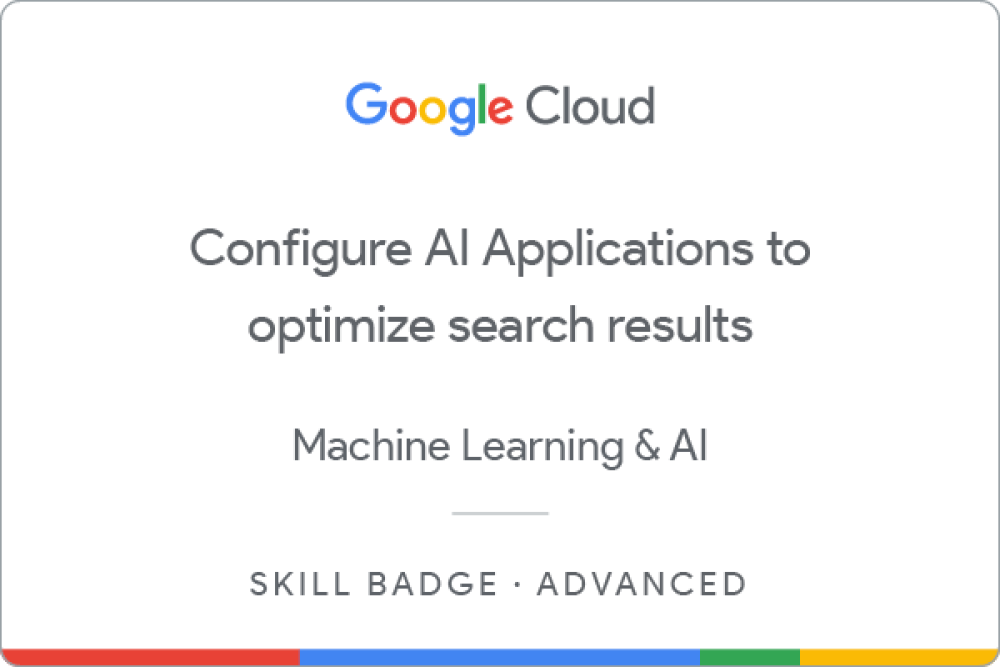 Configure AI Applications to optimize search results
Earned ago 8, 2025 EDT
Configure AI Applications to optimize search results
Earned ago 8, 2025 EDT
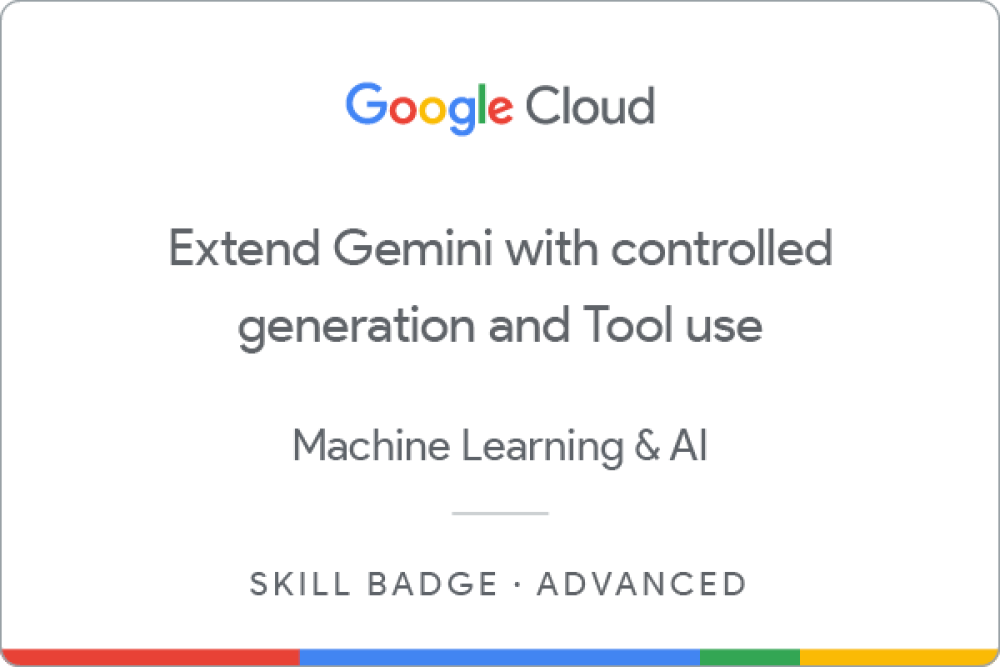 Extend Gemini with controlled generation and Tool use
Earned ago 6, 2025 EDT
Extend Gemini with controlled generation and Tool use
Earned ago 6, 2025 EDT
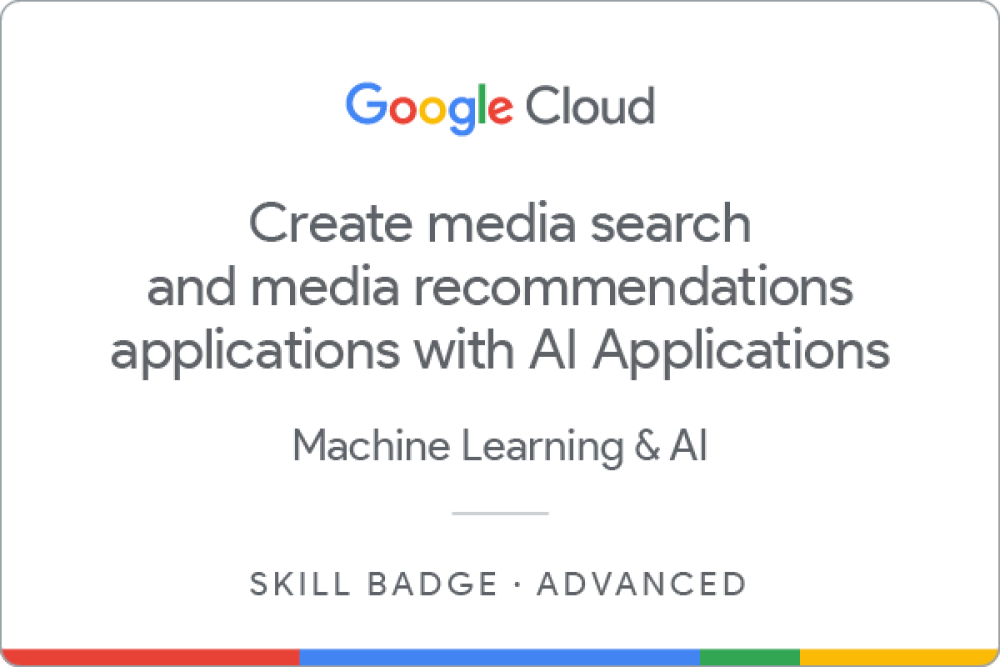 Create media search and media recommendations applications with AI Applications
Earned ago 4, 2025 EDT
Create media search and media recommendations applications with AI Applications
Earned ago 4, 2025 EDT
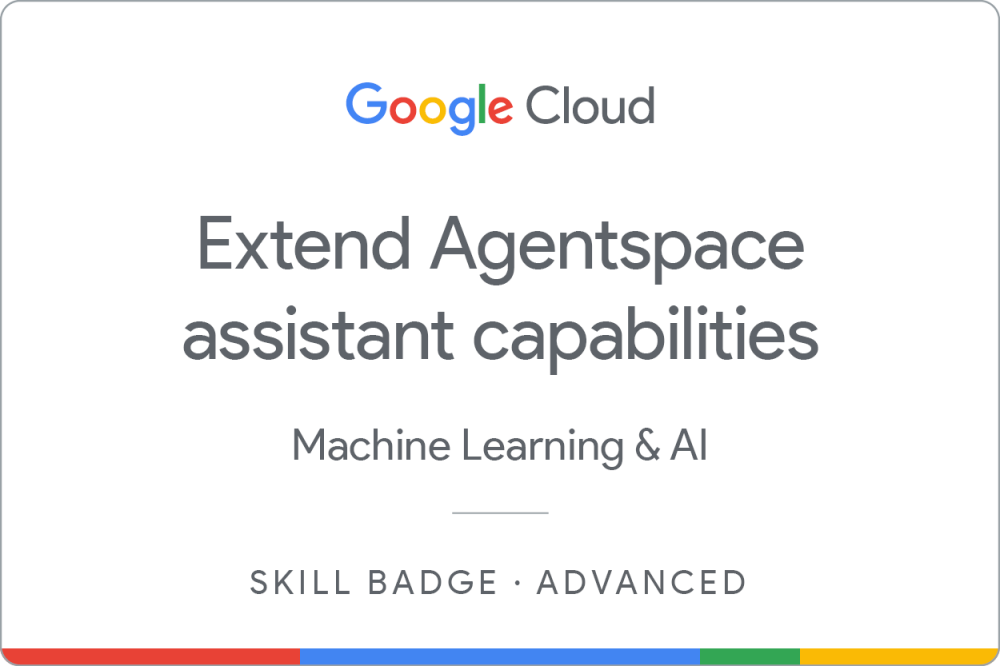 Extend Gemini Enterprise Assistant Capabilities
Earned ago 2, 2025 EDT
Extend Gemini Enterprise Assistant Capabilities
Earned ago 2, 2025 EDT
 Create Data Stores for Gen AI Applications
Earned lug 29, 2025 EDT
Create Data Stores for Gen AI Applications
Earned lug 29, 2025 EDT
 Create and maintain Vertex AI Search data stores
Earned lug 29, 2025 EDT
Create and maintain Vertex AI Search data stores
Earned lug 29, 2025 EDT
 Build search and recommendations applications with AI Applications
Earned lug 28, 2025 EDT
Build search and recommendations applications with AI Applications
Earned lug 28, 2025 EDT
 Custom Search with Embeddings in Vertex AI
Earned lug 16, 2025 EDT
Custom Search with Embeddings in Vertex AI
Earned lug 16, 2025 EDT
 Scaling with Google Cloud Operations
Earned giu 19, 2025 EDT
Scaling with Google Cloud Operations
Earned giu 19, 2025 EDT
 Trust and Security with Google Cloud
Earned giu 19, 2025 EDT
Trust and Security with Google Cloud
Earned giu 19, 2025 EDT
 Modernize Infrastructure and Applications with Google Cloud
Earned giu 18, 2025 EDT
Modernize Infrastructure and Applications with Google Cloud
Earned giu 18, 2025 EDT
 Innovating with Google Cloud Artificial Intelligence
Earned giu 18, 2025 EDT
Innovating with Google Cloud Artificial Intelligence
Earned giu 18, 2025 EDT
 Exploring Data Transformation with Google Cloud
Earned giu 16, 2025 EDT
Exploring Data Transformation with Google Cloud
Earned giu 16, 2025 EDT
 Digital Transformation with Google Cloud
Earned giu 16, 2025 EDT
Digital Transformation with Google Cloud
Earned giu 16, 2025 EDT
 Machine Learning Operations (MLOps) with Vertex AI: Model Evaluation
Earned giu 10, 2025 EDT
Machine Learning Operations (MLOps) with Vertex AI: Model Evaluation
Earned giu 10, 2025 EDT
 Prompt Design in Vertex AI
Earned mag 19, 2025 EDT
Prompt Design in Vertex AI
Earned mag 19, 2025 EDT
 Recommendations with AI Applications
Earned mag 16, 2025 EDT
Recommendations with AI Applications
Earned mag 16, 2025 EDT
 Working with Notebooks in Vertex AI
Earned mag 14, 2025 EDT
Working with Notebooks in Vertex AI
Earned mag 14, 2025 EDT
 Build a Data Warehouse with BigQuery
Earned mag 23, 2024 EDT
Build a Data Warehouse with BigQuery
Earned mag 23, 2024 EDT
 Serverless Data Processing with Dataflow: Foundations
Earned mag 13, 2024 EDT
Serverless Data Processing with Dataflow: Foundations
Earned mag 13, 2024 EDT
 Transformer Models and BERT Model - Italiano
Earned mag 8, 2024 EDT
Transformer Models and BERT Model - Italiano
Earned mag 8, 2024 EDT
 Attention Mechanism - Italiano
Earned mag 7, 2024 EDT
Attention Mechanism - Italiano
Earned mag 7, 2024 EDT
 Encoder-Decoder Architecture - Italiano
Earned mag 7, 2024 EDT
Encoder-Decoder Architecture - Italiano
Earned mag 7, 2024 EDT
 Introduction to Image Generation - Italiano
Earned mag 7, 2024 EDT
Introduction to Image Generation - Italiano
Earned mag 7, 2024 EDT
 Introduction to Responsible AI - Italiano
Earned mag 7, 2024 EDT
Introduction to Responsible AI - Italiano
Earned mag 7, 2024 EDT
 Introduction to Large Language Models - Italiano
Earned mag 6, 2024 EDT
Introduction to Large Language Models - Italiano
Earned mag 6, 2024 EDT
 Introduction to Generative AI - Italiano
Earned mag 6, 2024 EDT
Introduction to Generative AI - Italiano
Earned mag 6, 2024 EDT
 Smart Analytics, Machine Learning, and AI on Google Cloud - Italiano
Earned mag 4, 2024 EDT
Smart Analytics, Machine Learning, and AI on Google Cloud - Italiano
Earned mag 4, 2024 EDT
 Building Resilient Streaming Systems on Google Cloud Platform
Earned mag 1, 2024 EDT
Building Resilient Streaming Systems on Google Cloud Platform
Earned mag 1, 2024 EDT
 Creazione di pipeline di dati in batch su Google Cloud
Earned apr 27, 2024 EDT
Creazione di pipeline di dati in batch su Google Cloud
Earned apr 27, 2024 EDT
 Modernizzazione di data lake e data warehouse con Google Cloud
Earned apr 15, 2024 EDT
Modernizzazione di data lake e data warehouse con Google Cloud
Earned apr 15, 2024 EDT
 Preparing for your Professional Data Engineer Journey
Earned mar 5, 2024 EST
Preparing for your Professional Data Engineer Journey
Earned mar 5, 2024 EST
 DEPRECATED Build and Deploy Machine Learning Solutions on Vertex AI
Earned ott 22, 2023 EDT
DEPRECATED Build and Deploy Machine Learning Solutions on Vertex AI
Earned ott 22, 2023 EDT
 Introduzione all'AI e al machine learning su Google Cloud
Earned ott 2, 2023 EDT
Introduzione all'AI e al machine learning su Google Cloud
Earned ott 2, 2023 EDT
 Machine Learning Operations (MLOps): Getting Started
Earned set 18, 2023 EDT
Machine Learning Operations (MLOps): Getting Started
Earned set 18, 2023 EDT
 Production Machine Learning Systems
Earned set 10, 2023 EDT
Production Machine Learning Systems
Earned set 10, 2023 EDT
 Recommendation Systems on Google Cloud
Earned set 10, 2023 EDT
Recommendation Systems on Google Cloud
Earned set 10, 2023 EDT
 Natural Language Processing on Google Cloud
Earned set 6, 2023 EDT
Natural Language Processing on Google Cloud
Earned set 6, 2023 EDT
 Computer Vision Fundamentals with Google Cloud
Earned set 1, 2023 EDT
Computer Vision Fundamentals with Google Cloud
Earned set 1, 2023 EDT
 Machine learning in azienda
Earned ago 8, 2023 EDT
Machine learning in azienda
Earned ago 8, 2023 EDT
 Feature engineering
Earned lug 29, 2023 EDT
Feature engineering
Earned lug 29, 2023 EDT
 Crea, addestra ed esegui il deployment di modelli ML tramite Keras su Google Cloud
Earned lug 16, 2023 EDT
Crea, addestra ed esegui il deployment di modelli ML tramite Keras su Google Cloud
Earned lug 16, 2023 EDT
 Launching into Machine Learning - Italiano
Earned lug 4, 2023 EDT
Launching into Machine Learning - Italiano
Earned lug 4, 2023 EDT
 Google Cloud Big Data and Machine Learning Fundamentals - Italiano
Earned giu 4, 2023 EDT
Google Cloud Big Data and Machine Learning Fundamentals - Italiano
Earned giu 4, 2023 EDT
 Configura un ambiente di sviluppo di app su Google Cloud
Earned mag 5, 2023 EDT
Configura un ambiente di sviluppo di app su Google Cloud
Earned mag 5, 2023 EDT
 Infrastruttura Google Cloud elastica: scalabilità e automazione
Earned mag 5, 2023 EDT
Infrastruttura Google Cloud elastica: scalabilità e automazione
Earned mag 5, 2023 EDT
 Infrastruttura Google Cloud di base: fondamenti
Earned mag 4, 2023 EDT
Infrastruttura Google Cloud di base: fondamenti
Earned mag 4, 2023 EDT
 Google Cloud Fundamentals: Core Infrastructure - Italiano
Earned mag 2, 2023 EDT
Google Cloud Fundamentals: Core Infrastructure - Italiano
Earned mag 2, 2023 EDT
 Implementazione di Cloud Load Balancing per Compute Engine
Earned apr 28, 2023 EDT
Implementazione di Cloud Load Balancing per Compute Engine
Earned apr 28, 2023 EDT
 Preparing for Your Associate Cloud Engineer Journey
Earned apr 27, 2023 EDT
Preparing for Your Associate Cloud Engineer Journey
Earned apr 27, 2023 EDT
 How Google Does Machine Learning
Earned apr 20, 2023 EDT
How Google Does Machine Learning
Earned apr 20, 2023 EDT